A1
A1Absolute beginner
Basic words and phrases
Join the language platform with built-in live classes, a proven curriculum, and app-based practice to achieve your goals.




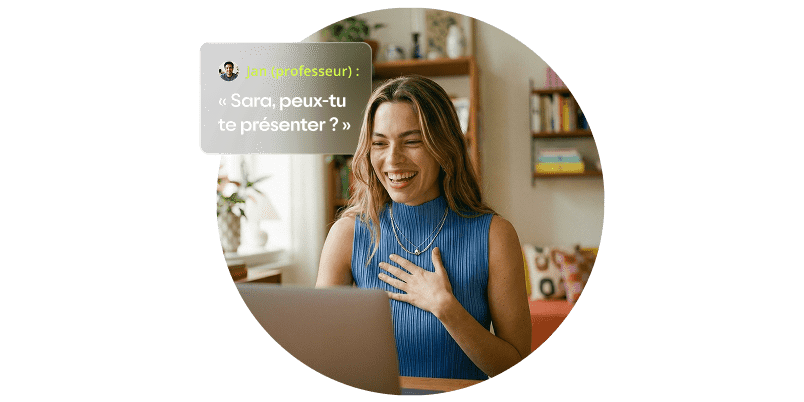

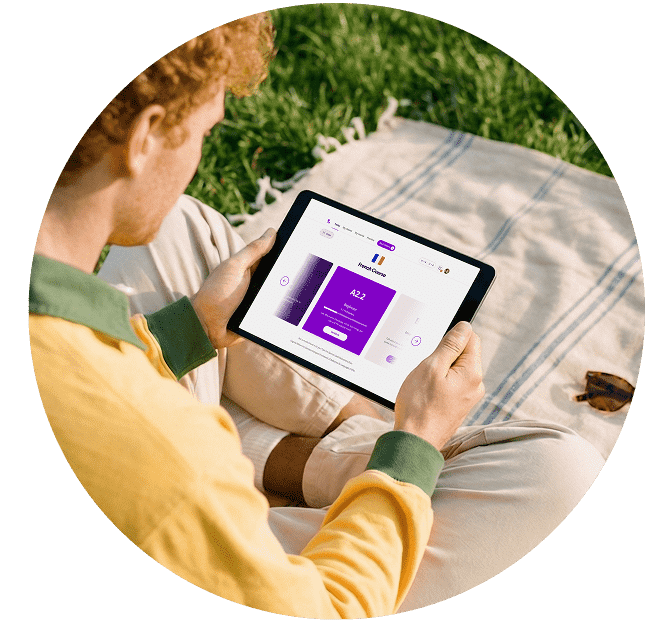
Grow your skills and opportunities with classes from beginner to advanced levels. Take our placement test to see where you fit.
Basic words and phrases
Handle simple interactions
Everyday conversations
Express complex topics
About CEFR levels
At Lingoda, we use the Common European Framework of Reference for Languages (CEFR), an international standard for language learning progress. It defines six levels, from Beginner (A1) and Elementary (A2) through Intermediate (B1, B2) to Advanced (C1). Each level builds on the one before, leading toward near-native fluency.
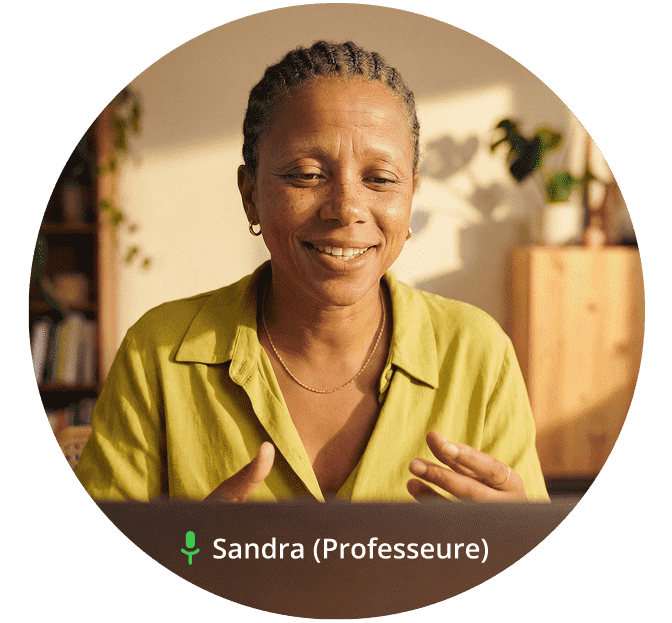
Learn about real-world topics you can learn today and use tonight. Our certified, native-level teachers turn complex grammar into clear conversation practice — bringing cultural nuances and local flavor to every class.

Use pronominal verbs to talk about your daily routine with greater accuracy.

Learn the structures, expressions, and vocabulary you need to talk about your free time.

Learn useful shopping phrases to ask for what you need and find the right section quickly.

Build the vocabulary and useful phrases to communicate clearly at the train station.
Learners achieved their goals
Live online language classes yearly
Learners speak confidently after Lingoda classes
Average class rating from Lingoda students
Our limited-time offer on Lingoda Flex monthly plans is for new students starting their language journey. Our smallest plan is excluded. The discount is applied immediately and is valid only for the first month’s purchase price. The offer cannot be combined with any other discounts or promotions and is only valid for new students.
As a Lingoda student, you can download the class materials for free and use them at any time. After your class, you will also find a quiz to help you refresh and practice your new skills. For English and A1 German students, downloadable exercises are available as well. All materials are uniquely created by Lingoda experts to align with CEFR standards. If you want to learn more about CEFR, view here.
After scheduling a French class on our platform, you will be able to join the class with 2-4 fellow students from around the world. The teacher will introduce themselves and begin teaching the lesson using learning materials that you can download at the end of class. You will be able to interact with the teacher and other students, but there is no pressure to do so. Towards the end of class, the teacher will recap the lesson and ensure everybody has understood the lesson.
Both group and private classes are very effective with Lingoda, but it depends on your personal preferences what you’d like to do.
No, we are not a language learning app. We are an online language school. And like any school, we offer live classes with certified, native-speaking teachers. At Lingoda, we believe that nothing can replace live interaction and customised feedback from a real person.
Preparing to learn French online with us is simple. You need three things: a stable internet connection, a computer and the free video conferencing tool Zoom.
It depends. As is the case when learning any new skill, your progress depends on your efforts. If you would like to learn French online quickly, then we suggest that you make language learning a consistent habit. Also focus and participate in class and complete the downloadable materials at the end of each class for best results. It also depends on which of Lingoda’s online French language courses you choose, as some of our plans are more intensive than others.
All of our French teachers are native speakers, no exceptions. They are also highly-qualified. We are strict with hiring only teachers that have years of experience and can provide the highest quality teaching. Our teachers are also trained with the Lingoda method and standard, so you can learn French online smoothly.
Learning French online is not enough? Then visit our Spanish page and learn Spanish online!
If you’d like to learn French, Lingoda is a good place to start. When learning any language, there are two main methods: working with a teacher in a group or individual class, or self-study, using books, online resources and apps. The more time you invest in learning French, the quicker you will learn the language. There are four main elements to language: listening, speaking, reading, and writing. In order to learn a language well, or to become fluent, it’s a good idea to cover these four bases.
Working with a teacher provides a structure for language learning and a step-by-step process. This is particularly useful as a beginner learner, as your teacher will be able to guide you based on your language level and learning style.
For self-study, there is a wealth of knowledge online about how to learn French and what resources to use. There are also many language apps which help you to practice things like vocabulary and reading.
In general, French is regarded as one of the relatively easier languages for English speakers to learn. Nevertheless, the language can present some challenges, primarily because it’s a Romance language, whereas English is a Germanic language. As a result, there are some fundamental differences in structure and grammar, which can take some time to get used to.
When you first start to learn French, it’s perfectly normal to find some grammatical concepts challenging, while pronunciation can also be tough in those early stages. However, with the right effort and some structured online French classes, you’ll be surprised at how quickly you can progress.
It’s worth noting that French is a widely spoken language with a huge presence in cinema, literature and international diplomacy. This means it’s relatively easy to immerse yourself in the French language.
When you learn French with Lingoda, you can select the level you wish to learn at. For the French language, we currently offer the following language levels:
In other words, we can teach students from a point of zero knowledge of the French language right up to a stage where they can read, write and speak French comfortably and with spontaneity. Whether you’re learning casually as a hobby or need to develop functional French for everyday use, we’ve got you covered.
For new learners with no real knowledge of French or knowledge of only the most common words, it’s as easy as starting at Level A1 and progressing through the different stages. With that said, we’re very aware that many learners come to us with some existing knowledge of the language, so it’s important to jump in at the right level. f you already know your current language level, feel free to dive in at that level, and you’ll fit right in. If you’re unsure of your French language level, don’t worry, as we have the perfect solution:
Take the Lingoda French language placement test!
The test is simple to understand and takes just five minutes to complete. By the end of the test, we’ll be able to provide you with an estimate of your current language level, allowing you to learn French online without covering old ground.
Yes — online can absolutely get you fluent when it includes live speaking, feedback, and consistency. With Lingoda, you’re learning with certified native-speaking teachers and a structured path up to B2 (often considered “comfortably conversational” for everyday and work situations).
The fastest path is usually: high-frequency live classes + targeted daily practice. Practically, that looks like doing an intensive block (e.g., Sprint: 15 or 30 classes/month) and then maintaining progress with a steady rhythm (Flex), while reviewing lesson materials and speaking out loud between classes.
For some learners, yes — especially if you’re consistent and get a lot of speaking time. A useful benchmark: the U.S. Foreign Service Institute lists Category I languages (including French) at roughly 600–750 classroom hours to reach professional proficiency, and most people need substantial practice time beyond class too.
Lingoda supports progression through A1–B2, so a 1-year B2 goal becomes more realistic if you’re doing multiple live classes per week (or an intensive Sprint period) plus regular self-study and exposure.
It’s the idea that a small set of high-frequency words, phrases, and situations drives a big share of real-life communication. In practice: focus first on the French you’ll use for work meetings, housing/admin tasks, healthcare, and social introductions, and repeatedly practice those scenarios in live classes so they become automatic.
Start with what creates the fastest “I can function” wins:
* Pronunciation basics (especially nasal sounds + liaisons)
* Survival phrases (introductions, asking for help, directions)
* Core verbs and sentence patterns (être/avoir/aller, present tense)
* High-frequency vocabulary tied to your daily life (work, apartment, errands)
Then use live classes to turn that knowledge into speaking confidence early.
It depends on the context:
* B2 is often “fluent enough” for independent life and many jobs because you can interact with fluency and spontaneity in regular conversations.
* C1 is a better target for advanced professional nuance (presentations, persuasion, complex writing).
Lingoda currently teaches French up to B2.
Take our quick and easy placement test