Why German social life feels locked — and how the door actually opens
The feeling often creeps in when you least expect it. You’re sitting with colleagues after work, the conversation moves easily, and you understand most of what’s being said. By now, you’ve been part of the team for a while. You have a routine, a functioning level of German, and a life that, from the outside, looks settled.


by Lea Hauke
Updated on May 19, 2026
At some point, you catch yourself wondering why you're still feeling alone. Everything suggests the opposite. You've been invited to things, you've had good conversations, you've spent time with people. But somehow, none of it seems to turn into something closer. You know many people, yet it rarely feels like they really know you or are trying to.
It's easy to take this situation personally, either as something you're missing or something that isn't working on their side. In many cases, though, the explanation lies elsewhere. German social life tends to follow patterns that are rarely made explicit, but still shape how relationships develop. What can feel like distance often belongs to a process that filters for long-term connection.
The harder truth is this: the signals you've been sending aren't wrong. They're just being read by a different system. In Germany, connection isn’t built on how quickly you click. It’s built on how consistently you show up.
The script that doesn't travel
Most people arrive in Germany running a social script that has worked their whole life reliably. The problem isn't the script; it's that it was written for a different system. And when that script stops working, the instinct is usually to double down on it.
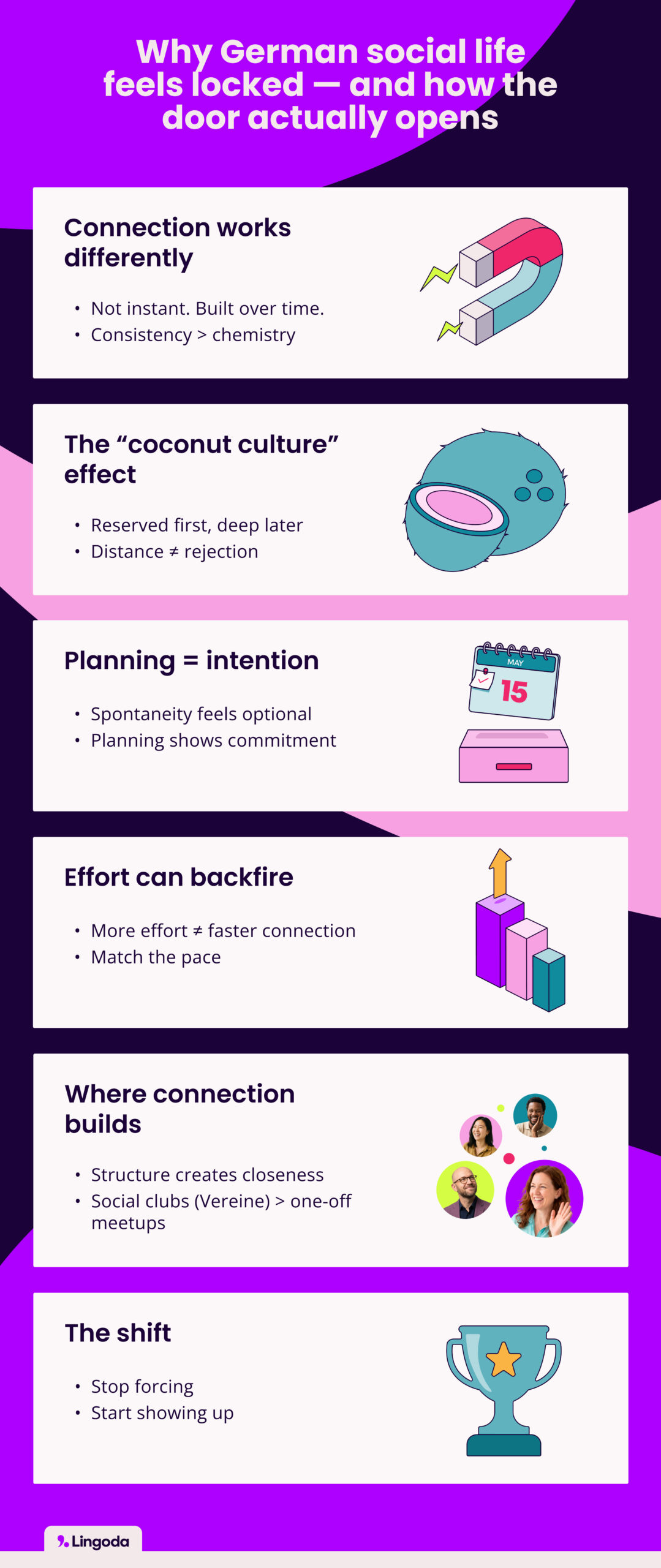
It's often described as the difference between "peach" and "coconut" cultures. If you come from a peach culture, such as the US, Brazil, or parts of southern Europe, you may be used to interactions that feel open and expressive from the beginning. Conversations start easily, small talk flows, and a sense of connection can form quite quickly. At the same time, that connection often stays at a lighter level for a while, with deeper familiarity building more gradually.
Coconut cultures tend to follow a different rhythm. The initial layer can feel more reserved, sometimes even distant. Especially in the beginning, interactions may come across as formal or slightly closed. Over time, though, relationships that do develop often become stable, loyal, and deeply rooted. Germany fits strongly into this pattern. For many expats, the difficulty lies in moving between these two systems.
That gap is something many people recognize almost immediately, even if they don't yet have the language to describe it. As an expat put it in this Reddit thread:
"Back in my home country it's easy to have a small talk from heart with anyone around and to make friends. People here [Bavaria] don't grasp that kind of attitude… It has been hard for me as a very social person to be left out like that."
If you're used to building connections through warmth and openness, you're likely bringing exactly those signals into your interactions. You ask questions, share small personal details, and try to create a relaxed atmosphere. In Germany, these signals are recognized and appreciated, but they are not usually treated as a strong foundation for a relationship. They are often understood as friendly yet non-binding.
In a coconut culture, social investment tends to build through repeated, consistent interaction. A single positive encounter does not carry much weight on its own. What matters more is whether you show up again, and then again after that. Familiarity grows through predictability over time. This applies to German work culture as well as to more informal social settings.




Learn German with Lingoda
How it works

Why effort makes it worse
At some point, you might send a message that feels completely harmless: "Hey, want to grab a beer tonight?" to create a stronger connection with a colleague or friend from uni. In many places, this is the easiest way to spend time together. It feels relaxed, low-pressure, and almost friendly by default. But in Germany, the response can be surprisingly hesitant. There might be a nerve-wracking pause. A "This week is a bit difficult." Or a suggestion to meet in two weeks.
What happened here? From your perspective, it was an open invitation. From the other side, it can feel a little different. Spontaneity is not a cultural no-go in Germany. But the end of the workday (Feierabend) is often treated as a clearly defined, sacred space. It's time that has already been mentally set aside, even if there are no fixed plans. When that space is approached at short notice, it can feel slightly intrusive, even if that was never the intention.
Planning ahead, in this context, carries a different meaning than many expats expect. Suggesting a specific day next week gives the interaction a sense of intention. It shows that time is being made, not just filled. A last-minute message can feel lighter, sometimes even optional, even if you meant it as a genuine invitation.
But it's not just timing. The same logic applies to the effort itself.
At a certain point, pushing harder stops helping in the way you might expect. You might try to be more open, more available, and more proactive: suggest plans, follow up, bring energy into conversations. The intention is clear. You want to connect. And yet the result often feels unchanged, sometimes even more distant.
This can be frustrating because the instinct itself is reasonable. In many cultures, connection grows when you lean in. In Germany, that same instinct often backfires. It can feel like you’re moving faster than the relationship is allowed to develop.
According to OECD data, around 90% of people in Germany say they have someone they can rely on in times of need — broadly in line with the international average. The connections are there. They just form more slowly and within a structure that rewards consistency over initiative.
Where the system actually runs
The frustration of feeling excluded usually comes from looking in the wrong places. Not wrong in the sense of bad choices, but wrong in the sense of spaces that don't accumulate.
Your colleagues seem friendly enough during the day, but after work they disappear into plans that were apparently made weeks ago. Weekends are "already full." Even casual suggestions rarely seem to turn into something concrete. If you've been wondering how to make friends in Germany, you've probably already noticed that one-off events rarely lead anywhere.
The good news is that the entry point exists. It just sits inside structures most people overlook.
Clubs and associations, Vereinswesen, are a big part of the German lifestyle. From football teams and choir groups to beekeeping clubs, gardening societies, or carnival committees. It's the kind of thing many expats first hear about and quietly think, "I did not move countries to join a beekeeping club."
The activity itself is almost irrelevant. When you join a club or Verein, you're stepping into a structure where people rely on each other in small, consistent ways. Someone organizes events, someone manages equipment, someone keeps things running. Over time, trust builds through shared responsibility. And simply because people keep showing up.
In contrast, if you're trying to meet people through bars, apps, or one-off events, you're in spaces that are easy to enter but difficult to build on. They generate interaction, not accumulation.
You might have a good conversation, exchange numbers, even meet again. But each interaction starts from zero. Nothing carries over.
In a Verein, things don't reset. You see the same people in the same place at regular intervals. You don't have to create a connection from scratch every time. It builds quietly in the background, simply because you're there. Friendship is the result, not the starting point. What tends to create real proximity is having a role within a shared structure—being the person who brings the equipment, organizes something small, or just shows up reliably over time.
There's a related concept that follows the same logic: the Stammtisch. A regular table, a fixed group, a predictable rhythm. This removes the need to keep initiating plans because the structure already does that for you—and allows everyone to relax.
What shifts when you stop performing connection
Once you understand the structure, the shift isn't about doing more—it's about doing differently.
The shift happens when you stop trying to accelerate the process and start working with the structure instead.
What tends to work is quieter and less visible at first. Not because it’s passive, but because it follows a different signal.
You show up at the same place regularly. You take on small responsibilities without drawing attention to them, plan ahead instead of relying on spontaneity. Over time, familiarity builds gradually in a way that feels natural for everyone involved. You also stop exhausting yourself trying to force something that isn’t meant to move that way.
Language plays a more nuanced role in this than it might seem. Vocabulary and grammar help you participate, but cultural understanding shapes how you move within the environment. When you understand why planning matters, why structured groups exist, and why initial distance is not rejection, it becomes easier to align your behavior almost automatically.
Reading the room, differently
If you think back to that moment at the table, it tends to look a little different with some distance. You hadn't missed anything obvious, and you hadn't done anything wrong. You showed up, you engaged, and you did what would usually lead to connection in many other places. What felt like a gap was less about rejection and more about navigating German social life without a clear sense of its underlying structure..
Once you recognize the structure, the experience shifts. The slower pace feels less frustrating, the distance less personal, and the whole process a bit more predictable. It doesn't suddenly become effortless, but it becomes easier to understand why things unfold the way they do.
The door was never locked. You were just looking for the wrong kind of handle.
Like most things in this context, understanding cultural nuances develops gradually and takes time. To help you achieve this more easily, German courses at Lingoda are taught by certified, native-level teachers. They encourage you to speak more freely in a safe environment before you test your skills out in the wild.
Learn German with Lingoda
How it worksLea Hauke
Lea is a writer and translator for English and German and lives in Austria. Her love for literature is only met by her enthusiasm for music. During her studies in Berlin, she started writing for different music magazines and was the singer and drummer of a punk band. When she completed her Masters in English Literature, she moved to Tyrol, where she started her own business. Since then she has made it her mission to help others to find the right words for their ideas and projects. You can find more information about her on her website and on LinkedIn.