Why you don’t get German humor yet (and what that actually says about belonging)
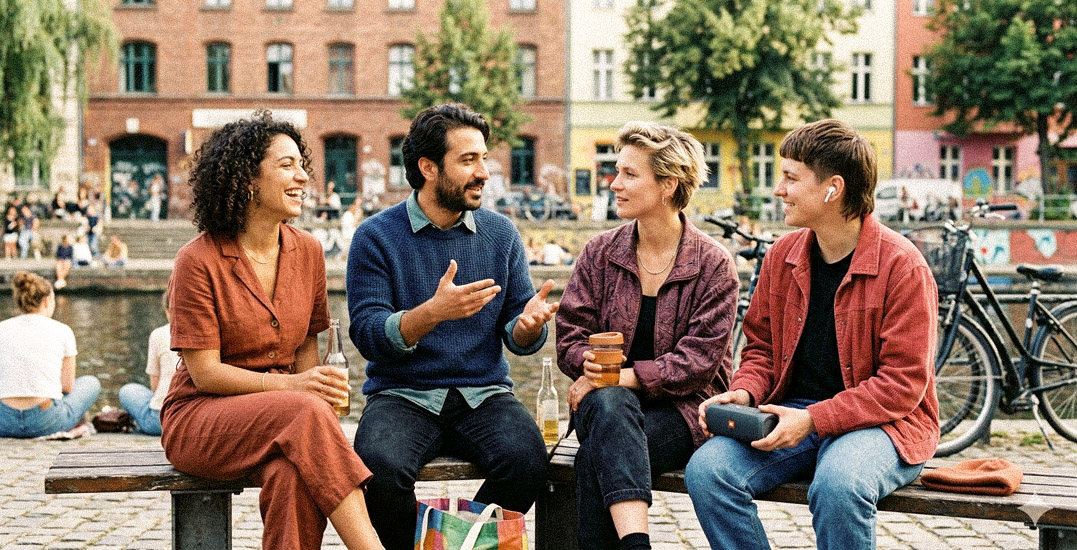
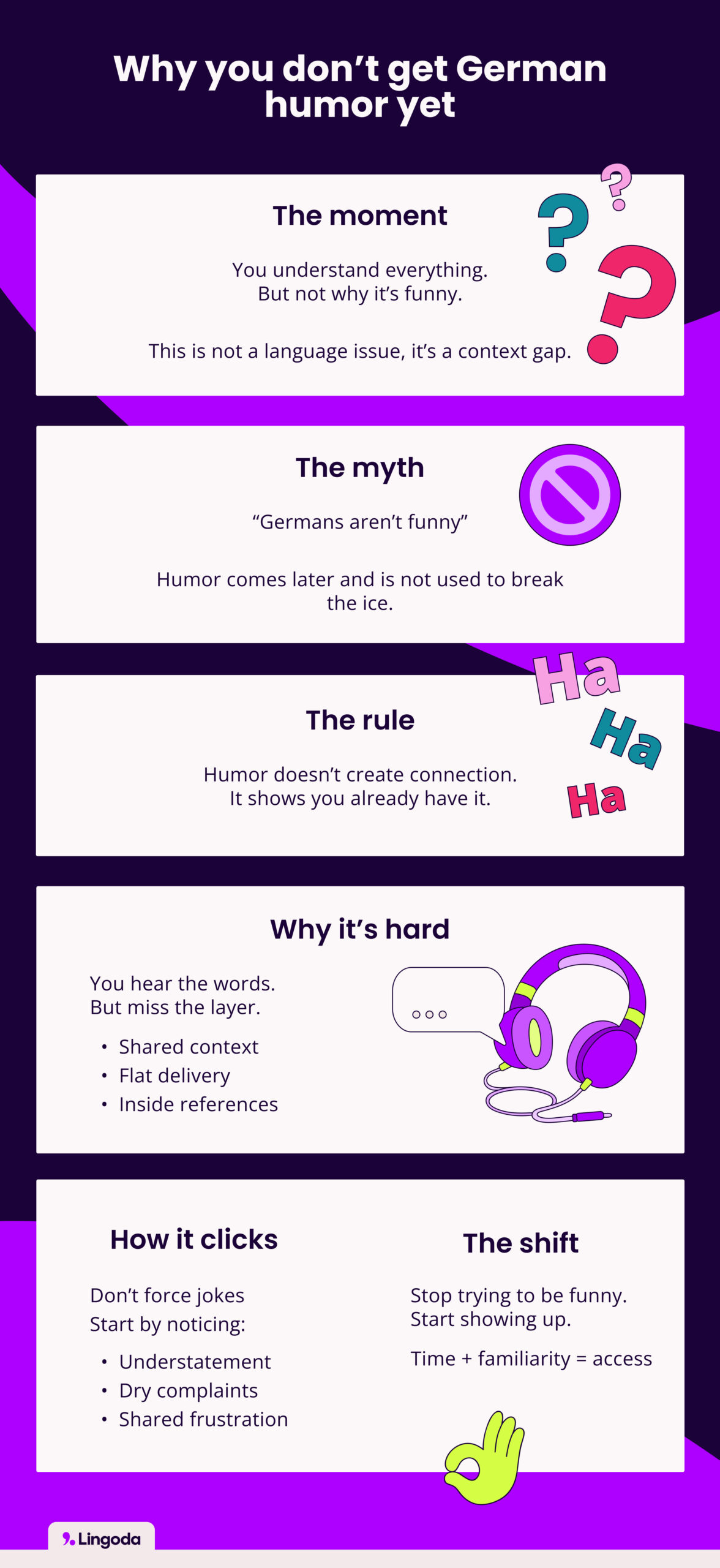
Someone at work makes a comment, everyone’s losing their minds laughing, but you’re left doing a quick internal check: Even though you caught every word, you’re not entirely sure why it was funny. So you default to a safe response. A small smile, maybe a short laugh, just in case.
What makes this moment so disorienting is that nothing is actually missing. You understood the sentence, you followed the conversation, and yet you’re still not fully in it. That’s where this strangely specific confusion about German humor comes from. You’re not lost, just slightly out of step. The tone, the timing, the moment where something shifts from normal to funny. So what’s missing?


by Lea Hauke
Updated on May 19, 2026
Everything else works. You speak German well enough to get through your day, hold conversations, and even handle meetings without switching back to English. This is obviously not a vocabulary issue. And against popular belief, it’s definitely not that Germans aren’t funny. If anything, they seem very funny with each other.
Which leads to a more uncomfortable conclusion: if you’re not missing the language, you’re missing the context that makes the humor land.
The answer lies less in what is being said and more in how and when it’s said. German humor follows a kind of social contract that depends on shared context and familiarity, and until that contract becomes visible, it can feel like you’re always just outside the rhythm of it.
The myth that won't die
There’s a stereotype that comes up almost every time German humor is mentioned. Germans just aren’t that funny. It’s an idea that has been repeated often enough to feel almost factual, especially in British and American contexts, where humor tends to serve a very specific purpose. It works as a social lubricant. You make jokes with people you’ve just met, use self-deprecation to ease tension, and rely on small talk to create a sense of connection. In that setting, humor is less about the joke itself and more about what it signals: openness, warmth, a willingness to engage.
When that expectation is applied to Germany, the conclusion almost writes itself. But that conclusion has been challenged quite directly. In her BBC article Why people think Germans aren’t funny, Amy McPherson points out that the stereotype says more about the observer than about German humor itself. Comedy clubs in Berlin are thriving, political satire has a long tradition, and formats like Kabarett show a clear appetite for complex, often socio-critical humor. The issue is not the absence of humor, but how it is being read.
If humor is expected to appear early, to smooth interactions and reduce distance, then a system in which humor appears later will naturally feel lacking. But what looks like silence at the beginning is often just a different sequencing.
In Germany, humor tends to emerge once a certain level of familiarity is established. It doesn’t usually lead the interaction, and it isn’t used to create immediate ease with strangers. Instead, it appears later, once a shared context exists. From the outside, this delay can look like an absence. From the inside, it simply follows a different logic.
At the same time, the idea that German humor is limited doesn’t hold up when you look at the cultural tradition itself. Concepts like Galgenhumor reflect a long-standing tendency toward dry, often dark humor that finds its effect in understatement. Post-war absurdism adds another layer, where the comedy often lies in taking social norms or bureaucratic logic to their extremes.
Loriot is a good example of this approach. His sketches revolve around painfully awkward situations that are played completely straight, where the humor builds slowly and depends on the viewer recognizing the tension beneath the surface. Nothing is explained, and nothing is exaggerated for effect.
Take his famous Nudelnuss sketch: a husband attempts to eat a piece of pasta that has fallen on his nose during a dinner party. Neither he nor his wife acknowledges it directly. The scene plays out in total, agonizing deadpan — every attempt to restore normality only deepens the absurdity. The joke is never announced. It simply accumulates. This is very much the signature of German humor at its best: the comedy lives in what is not said.
A lot of what people find funny in Germany today, from subtle everyday observations to highly specific German workplace references, becomes much clearer once you start engaging with things like German memes, which often rely on exactly the kind of shared context newcomers are still building.
Seen from this perspective, the stereotype isn’t just inaccurate. It becomes actively misleading. It suggests that something is missing when in reality, something is simply being overlooked. And if you’re trying to integrate, that distinction matters, because it changes what you pay attention to.



Learn German with Lingoda
How it works

The social contract of German humor
This difference becomes especially visible in professional or more formal settings. A manager’s self-deprecating joke, for example, may soften the atmosphere in some cultures by making the interaction feel more equal and relaxed. Humor signals approachability.
In Germany, that function is less automatic.
Professional roles often remain more clearly intact, especially before people know each other well, and humor is not always expected to smooth that over. It may still appear, but it usually does not have to do the work of reducing distance at the beginning of an interaction. Instead, it tends to become possible once the relationship has already shifted into a more familiar mode. Which means humor isn’t the tool that gets you in; it’s the signal that you’re already in.
This is why the difference is better understood as structural rather than personal. The boundary between public and private interaction is more clearly defined. What happens within a close group operates under different conditions than what happens in more open or newly formed situations. Humor belongs more strongly to that inner space. It is not absent, but it is not automatically available.
Within this framework, humor functions less as an opener and more as a signal. When someone is genuinely funny with you, they are not just performing for the group. They are indicating that you are now part of a context where that kind of expression is appropriate. The tone shifts, the delivery becomes more relaxed, and the range of what can be said expands. It reflects how you are being positioned within the group.
This helps explain why even highly fluent speakers can still feel slightly excluded.
If most of your interactions take place in settings where relationships are still forming or remain relatively formal, you are primarily encountering the public version of the system. The humor exists, but it is not being directed at you yet. Not because it is being withheld, but because the conditions for it have not fully developed.
You cannot shortcut this process by becoming more verbally skilled or by trying to introduce humor yourself in the early stages. In many cases, that approach creates a slight mismatch with the situation. What matters more is time, shared experience, and the gradual shift from public interaction to something more familiar.
Why fluency isn't enough
After investing time and effort into learning German, often reaching a solid B2 level or higher, everyday communication starts to feel manageable. Conversations at work become easier, meetings can be handled without switching languages, and the sense of progress is real. From a linguistic perspective, very little seems to be missing. And yet, something as seemingly simple as humor continues to feel out of reach.
The difficulty lies in the fact that the gap is no longer about understanding words but about interpreting what sits around them. At this stage, language stops being the barrier — and starts exposing a different one. A sentence can be fully comprehensible and still not register as a joke, or register too late, or in a way that doesn’t align with how others react. What appears straightforward on the surface carries an additional layer of meaning that isn’t explicitly marked. Even advanced learners often recognize the words but miss the intention behind them, which is why understanding funny German idioms tends to be less about vocabulary and more about exposure over time.
This is often described by expats themselves in ways that point to a structural difference rather than a linguistic one. In a Reddit thread dedicated to this topic, one user explained that German humor seems to exist in separate layers, with “one for public display, one shared with friends, and one for family only.”
The observation is simple, but it captures something essential. Even with strong language skills, access may be limited to the outer layer, while the more nuanced forms of humor remain tied to familiarity and shared experience.
Part of this has to do with context. Certain forms of Galgenhumor, for example, rely on references to social norms, bureaucracy, or historical experience that are not explained within the interaction itself. They are assumed as common ground. Without that shared background, the humor remains technically visible but functionally distant.
Another factor is delivery. Irony and sarcasm are often expressed without clear tonal markers, sometimes in a way that is deliberately indistinguishable from sincerity.
A colleague might say, completely flatly, "Na, das war ja wieder ein voller Erfolg" — "Well, that was a resounding success" — after something has clearly gone wrong, with zero change in tone, no smirk, nothing. To a newcomer, it can sound like genuine satisfaction. To someone who has spent time with that person, the irony is obvious.
Interpreting them depends less on the sentence itself and more on knowing how a particular person tends to speak, which takes time to develop.
This is where linguistic fluency reaches its natural limit. It allows you to participate in the conversation, but not necessarily to interpret every layer of meaning within it. As a result, the frustration persists not because progress is lacking, but because the missing piece requires a different kind of understanding.
How you actually earn your way in
Forcing German jokes can create a very specific kind of awkwardness. Imagine a meeting where the atmosphere is still relatively formal. You try to lighten the mood with a quick joke, something that would usually land easily. There’s a short pause, a polite smile, and then the conversation moves on as if nothing happened. No one reacts negatively, but no one really picks it up either. The moment simply… dissolves.
The instinct behind it makes sense, so don’t shame yourself for trying. In many contexts, humor is a great way to create connection, but in other situations, it can come too early, before people are ready for it, and can end up feeling slightly out of sync with the group's tone.
A more useful shift is quieter and slightly counterintuitive. Instead of focusing on producing humor, move your attention towards recognizing it at first. This isn’t about holding back. It’s about noticing that humor in this context is something you’re gradually allowed into, not something you perform your way into. This may feel less active at first, almost like stepping back rather than stepping in. But in practice, it’s how most people learn any unfamiliar humor system. You start by noticing what others find funny, what gets repeated, what is being subtly undercut, long before you try to contribute something of your own.
In the German context, that recognition depends heavily on shared context, which takes time to build. Many jokes lean on things that are never explicitly explained. A passing comment about paperwork, a reference to a well-known inefficiency, a dry remark about something that “works perfectly” when it clearly doesn’t. On the surface, these can sound almost disappointingly literal. The humor only appears once you know what is being gently taken apart underneath.
A few patterns are worth learning to spot early. The first is the understatement as complaint: something is described as "not ideal" or "a bit unfortunate" when the situation is, objectively, a disaster. The second is the bureaucracy joke: a dry reference to a form, a process, or a rule that everyone present knows is absurd, delivered as if it were simply a fact. The third is the shared-suffering laugh: two people briefly and without elaboration acknowledge that something universally annoying has happened again. None of these are signposted. They tend to land quietly. But once you start recognizing them, they appear constantly.
Spending time in conversation with native speakers is less about learning how to tell jokes and more about slowly collecting reference points. Over time, certain themes return, certain patterns become familiar, and what once felt flat starts to carry a second meaning. It’s not a sudden shift, and it rarely announces itself, but it accumulates.
In on the joke
There’s no need to rehearse jokes in German before a meeting or to mentally prepare a clever comment for the right moment. The moment where everyone laughed and you didn’t was never about being quick enough or fluent enough. It was a snapshot of something less visible. You were following the conversation, just not yet the layer it was operating on.
Seen that way, it becomes easier to place. Not as a failure, but as part of the process of moving from understanding German to understanding German humor.
And that process doesn’t speed up through effort alone. It depends on time, on familiarity, on enough common ground for the gap between what is said and what is meant to begin to close.
What actually changes things is repetition in the right environment: seeing the same people regularly, building shared context almost without noticing. The format matters less than the consistency of it — returning to the same small group of native speakers, week after week, builds the kind of shared reference points that humor depends on almost without you noticing. That’s also why structured environments like Lingoda’s small-group German courses can accelerate this shift: not by teaching humor directly, but by recreating the conditions it depends on. Not because it’s the fastest way to learn grammar, but because it mirrors the kind of repeated exposure that actually closes the gap. Eventually, the reaction comes without thinking. The moment no longer stands out. And that's when you know you're in.
Learn German with Lingoda
How it worksLea Hauke
Lea is a writer and translator for English and German and lives in Austria. Her love for literature is only met by her enthusiasm for music. During her studies in Berlin, she started writing for different music magazines and was the singer and drummer of a punk band. When she completed her Masters in English Literature, she moved to Tyrol, where she started her own business. Since then she has made it her mission to help others to find the right words for their ideas and projects. You can find more information about her on her website and on LinkedIn.