8 best apps to learn German in 2026
Apps are an easy, quick way to start learning German.

by Riya Dosani
Updated by Creative Team on August 4, 2026
There are hundreds out there, and they're not all built for the same job: some focus on vocabulary and grammar, others on listening, but only a few are designed to get you speaking.
Below, we cover the big names you already know, plus a few smaller apps worth adding to your routine. We'll tell you what each one does best, what it costs in 2026, and where it falls short, so you can build a toolkit that actually covers your gaps.
How the apps compare: a summary
| App | Best for | Price (2026) | Free tier | Level range |
| Duolingo | Daily habit, vocabulary | Free; Super ~$84–96/yr; Max ~$30/mo | Yes | A1–B1 |
| Babbel | Grammar structure | ~$8.95/mo (annual); Lifetime ~$299 | First lesson only | A1–B2 |
| Pimsleur | Speaking and pronunciation | ~$20/mo; All Access ~$21/mo | No | A1–B1 |
| DW Learn German | Free structured course | Free | Yes, fully | A1–C1 |
| Memrise | Native-speaker immersion | Free tier; Pro ~$23/mo | Yes | A1–B1 |
| Drops | Quick vocabulary games | Free (limited); ~€5/mo unlimited | Yes | A1–A2 |
| Tandem | Speaking with natives | Free | Yes | Any |
| Der Die Das | German articles and genders | Free | Yes | Any |
Duolingo
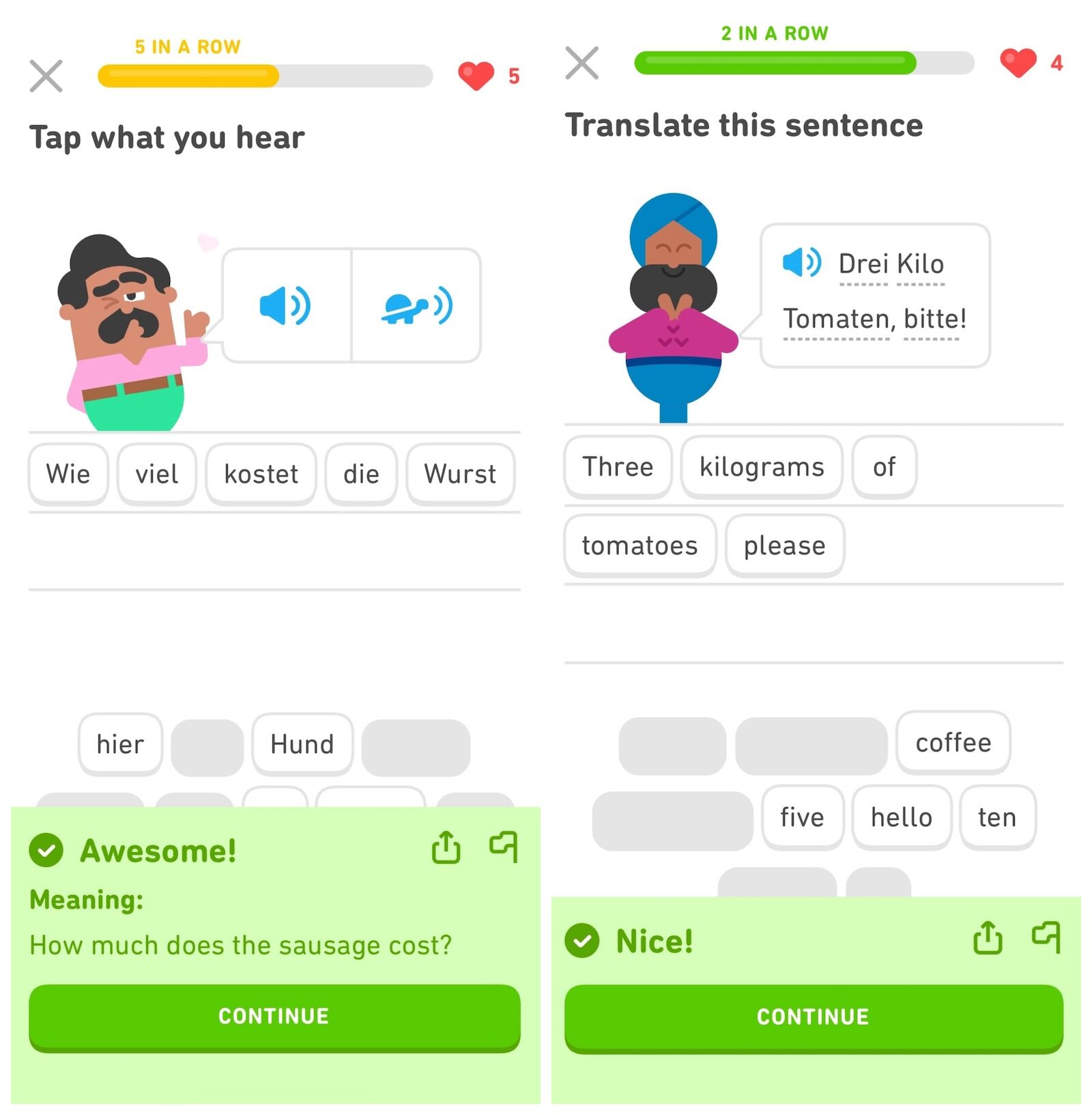
Duolingo is still the easiest way to start learning German: it's free, gamified, and quick to open for a few minutes a day. In 2025, Duolingo replaced its old hearts system with Energy, which drains a little with every exercise and refills over time (or with a top-up). On the upside, its AI features include Explain My Answer, which breaks down why you got something wrong. It is now free in the German course, and Duolingo Max adds AI video calls with a virtual conversation partner.
Our take: Duolingo is brilliant at getting you to show up. The streaks work, and after a few weeks you'll recognize a surprising amount of vocabulary. Then you try to build your own sentence and realize the app never explained why the words go where they go. It builds the habit; it doesn't build the grammar.
Price (2026): Free with limited Energy; Super costs around $84–96 a year. Duolingo Max with the AI features runs about $30 a month.
Good for: Building a daily habit and picking up vocabulary fast.
Limitation: Duolingo still doesn't explain grammar in much depth, so cases, genders, and word order (German's real hurdles) usually need another resource.
Babbel
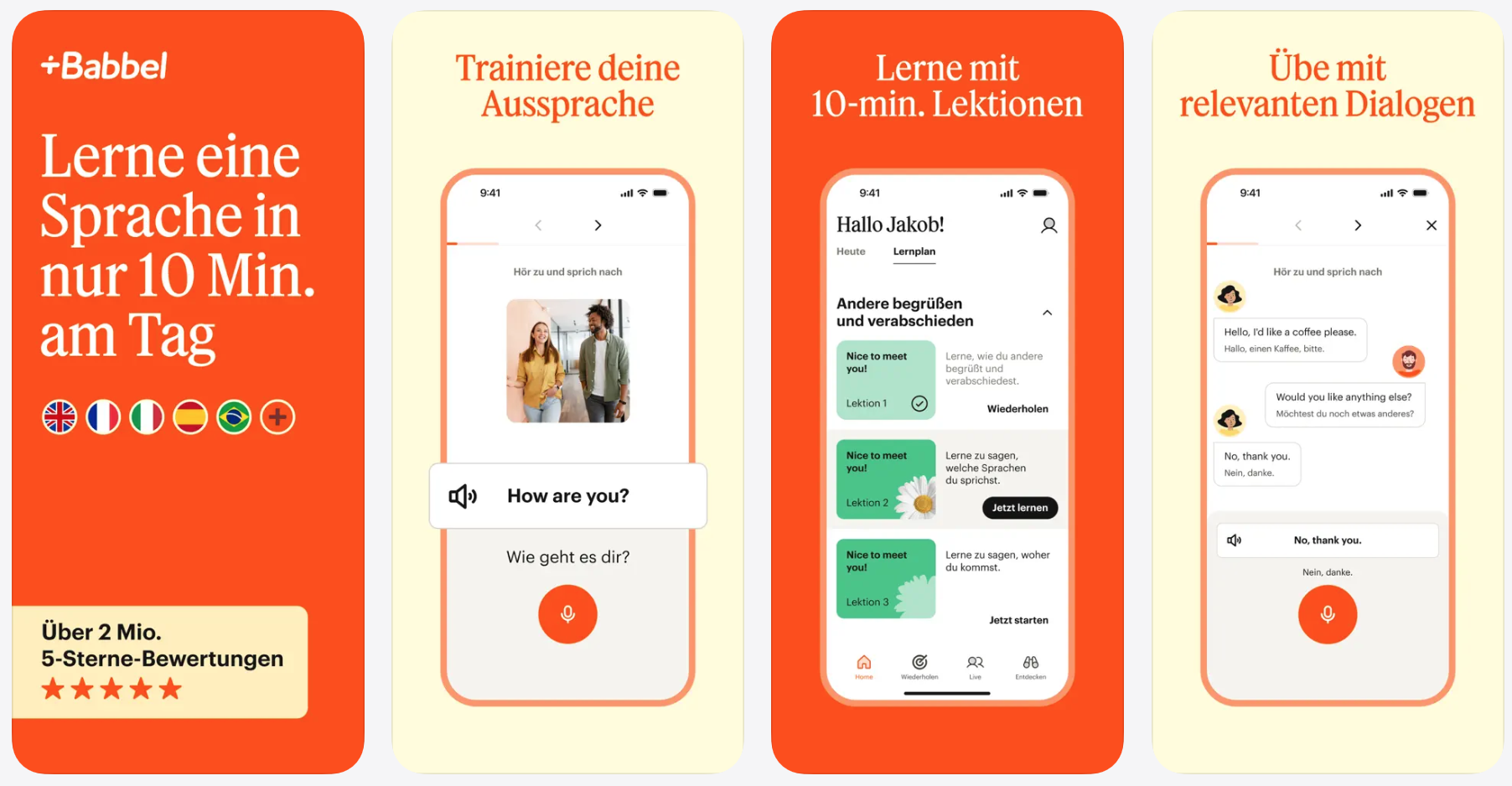
Babbel reads more like a course than a game. Its lessons explain grammar as you go, which makes it a solid next step after Duolingo, or a good starting point if you want structure from day one. The annual plan runs about $8.95 a month, billed yearly, or you can buy a Lifetime plan (all languages) for around $299, often discounted lower. Babbel retired its live-class feature in 2025 and replaced it with an AI conversation partner, Babbel Speak, plus short podcasts and review games.
Our take: Babbel feels like the app equivalent of a well-organized textbook (in a good way). When it introduces the accusative case, it actually tells you what's happening and why. The lessons are calmer and less flashy, which some learners find refreshing and others find a little dry. If you want to understand the rule before using it, this is your app.
Price (2026): ~$8.95/month billed annually. Lifetime around $299.
Good for: Clear grammar explanations rather than pure repetition.
Limitation: There's no real free tier beyond the first lesson, so you can't try much before paying.
Pimsleur
If speaking is your main goal, Pimsleur takes a different approach: it's almost entirely audio, built around listening and repeating rather than games or reading. It now includes speech recognition, so the app can check your pronunciation as you learn.
Our take: Pimsleur is the one app on this list that gets you speaking out loud from the very first lesson. The 30-minute audio format is oddly effective: phrases come back right before you'd forget them, and pronunciation improves without you noticing. It does feel slow if you're a visual learner, and you'll finish a level knowing fewer words than with Duolingo, but pronouncing them far better.
Price (2026): Around $20/month for German alone, or about $21/month billed annually for ‘All Access’ to every language.
Good for: Pronunciation and listening comprehension, especially if you learn best by ear.
Limitation: There's little visual or written practice, so pair it with another app if you also want to read and write confidently.
DW Learn German
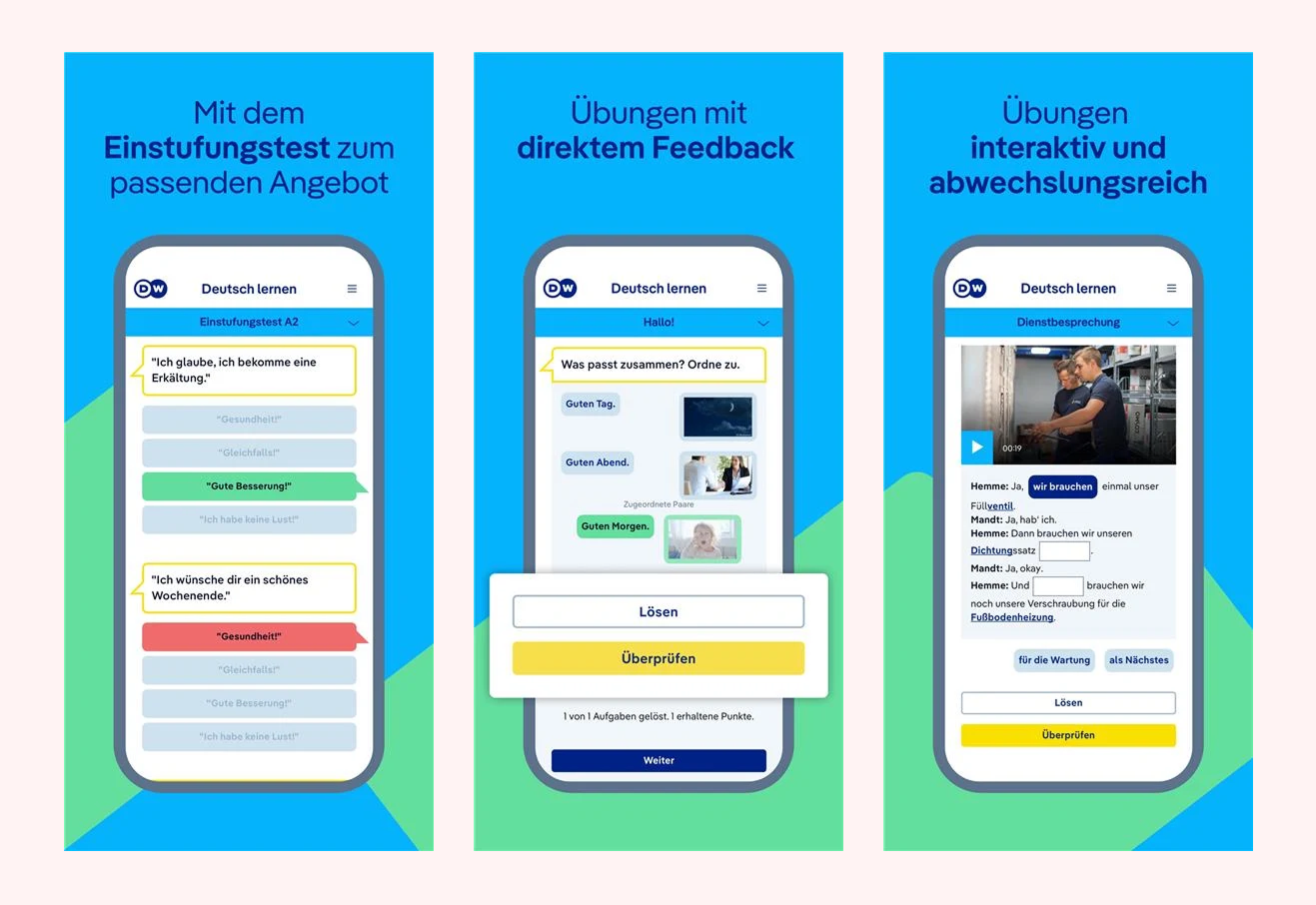
From the broadcaster Deutsche Welle, DW Learn German is the strongest fully free option on this list. After a placement test, you'll follow story-based courses; Nicos Weg is the best-known, which takes you from A1 all the way through B1, with some material reaching C1.
Our take: Nicos Weg follows one character's story through hundreds of short video episodes, so grammar and vocabulary arrive in context instead of as isolated drills. Ask around in any German-learning community, and this is the free resource people recommend most, for good reason.
Price (2026): Free.
Good for: A genuine free course with real structure, not just isolated exercises.
Limitation: The interface feels dated next to newer apps, and there's no built-in speaking practice.
Memrise
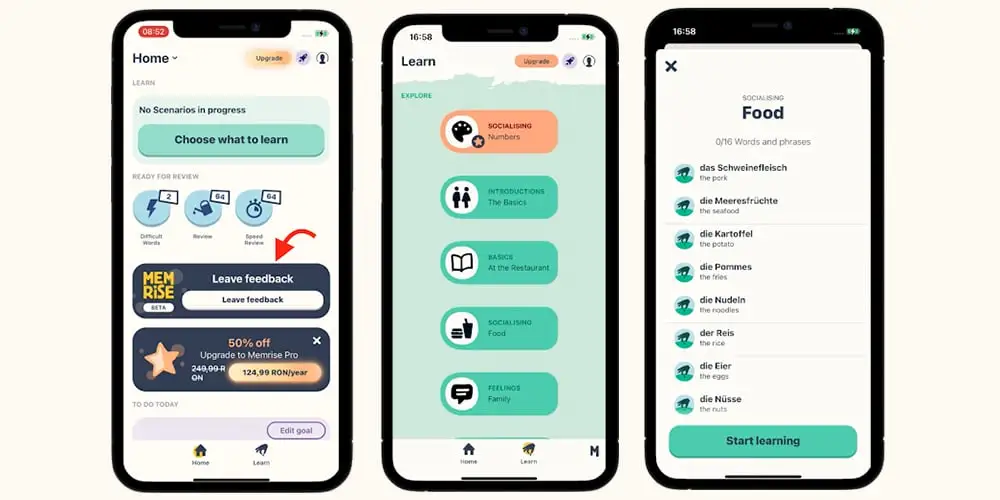
Memrise has changed shape since its flashcard-only days. It's now built around real-life scenarios, short native-speaker videos (Immerse), and an AI chat partner called MemBot that lets you practice conversations in context. One thing to know: the redesigned version dropped offline mode, so you'll need a connection to use it.
Our take: The native-speaker videos are Memrise's superpower. Hearing a real person say Was geht ab? on a street in Berlin prepares you for how Germans actually sound (fast, and not like your textbook). The redesign divided long-time fans, and we understand why: it's slicker but shallower in places.
Price (2026): Free tier available; Memrise Pro runs about $23/month, or roughly $90/year.
Good for: Hearing natural, native-speaker German instead of robotic audio.
Limitation: No offline access, and the deeper AI conversation features sit behind the paid tier.
Drops
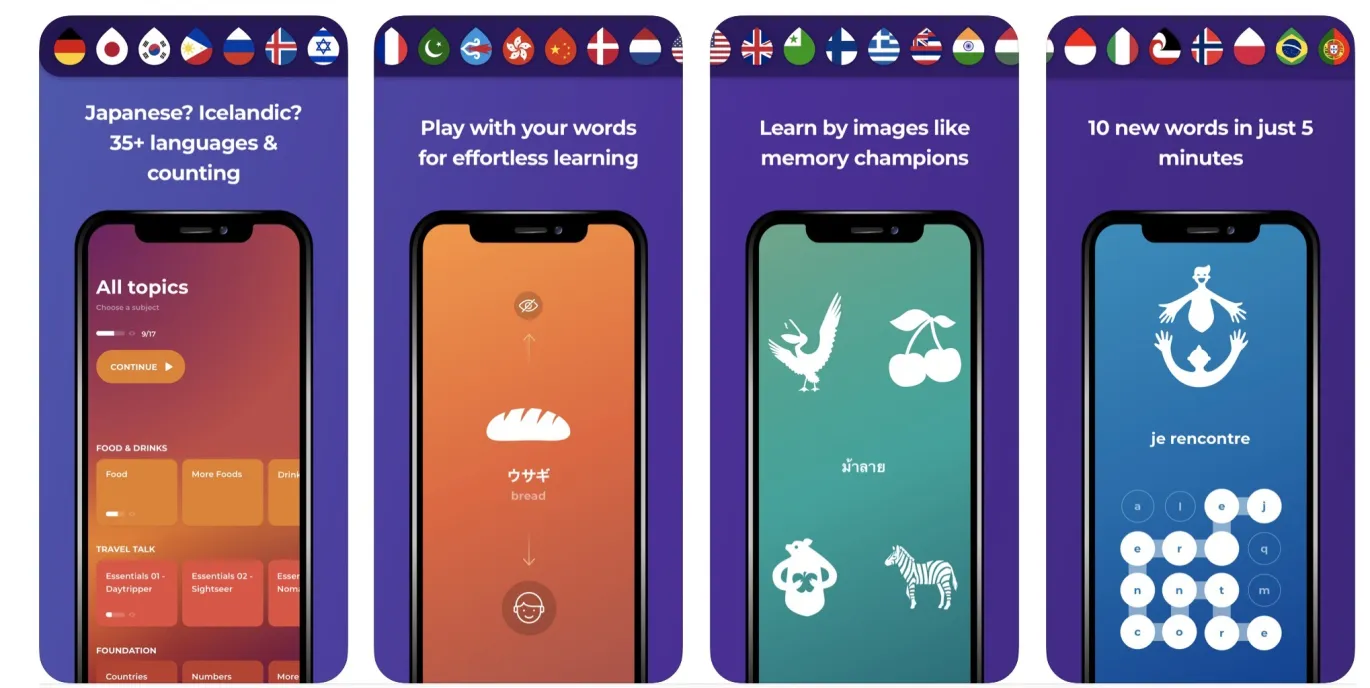
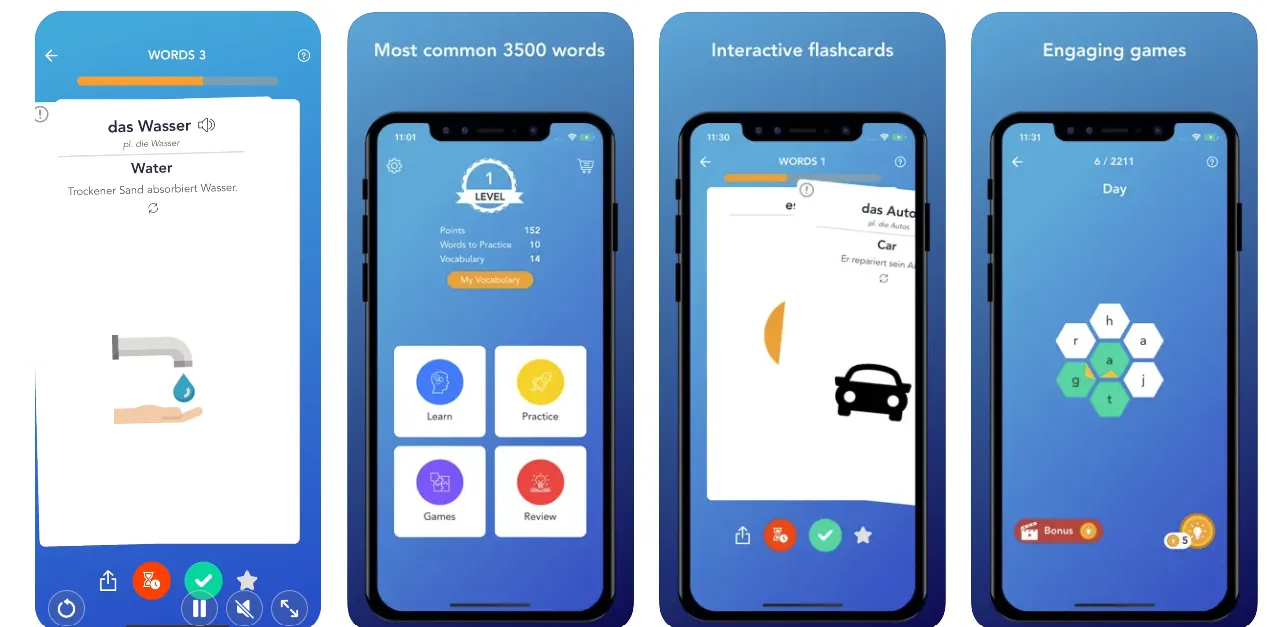
If flashcards feel like a chore, Drops turns vocabulary into a quick, colorful game: you'll match German words to images in short daily sessions, using spaced repetition to help new words stick. Now owned by Kahoot, Drops has added grammar lessons for German on top of its original vocabulary focus.
Our take: Drops is the app we'd recommend for the five minutes you'd otherwise spend scrolling. The five-minute daily limit on the free version sounds restrictive, but it's actually clever: sessions end before your attention does, so you come back tomorrow. Although you'll learn words, not sentences, and you can't hold a conversation made of nouns.
Price (2026): Free version with a daily time limit; unlimited access costs about €5/month on an annual plan.
Good for: Building vocabulary in short, low-pressure bursts.
Limitation: Still vocabulary-first, so pair it with a grammar-focused app.
Tandem
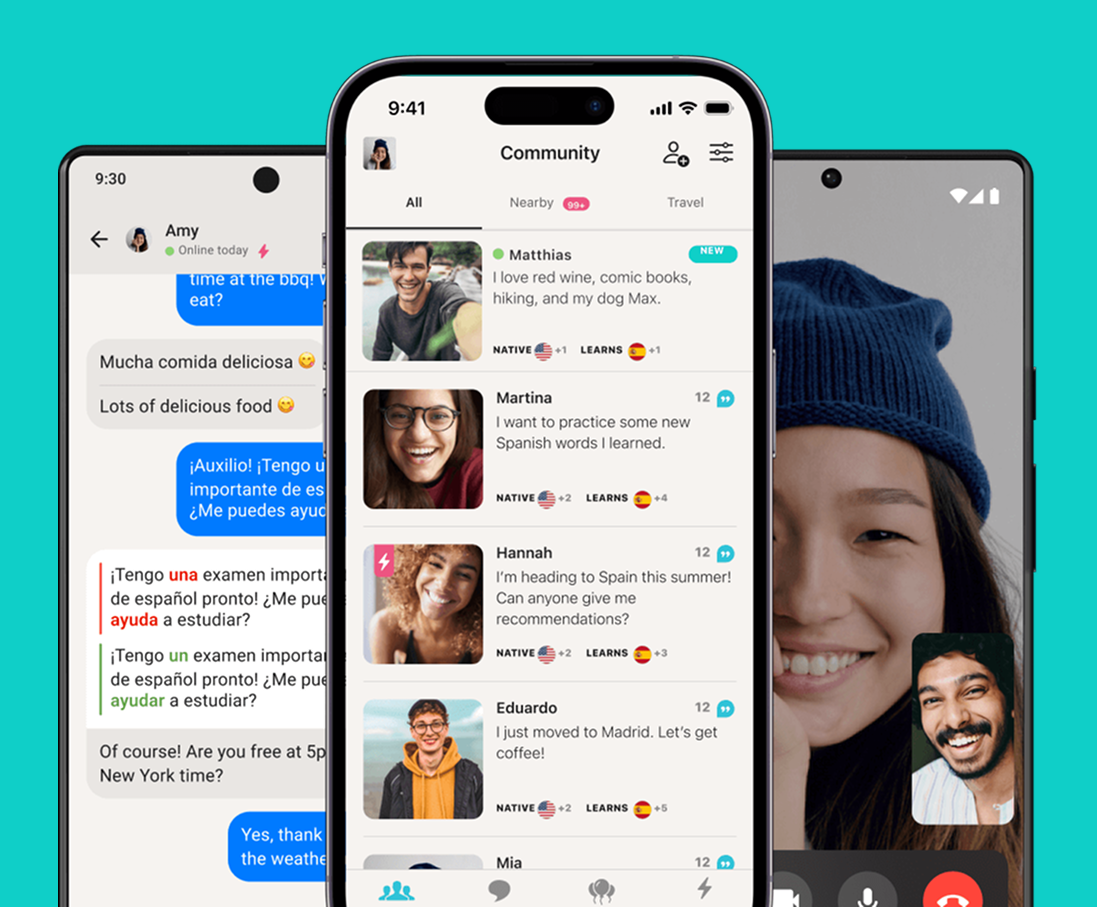
Apps can only take you so far before you need to actually talk to someone. Tandem connects you with native German speakers who want to learn your language in return, so you can message, voice chat, or video call for free speaking practice.
Our take: Your experience on Tandem depends almost entirely on who you find. A good partner is worth more than any subscription: someone who corrects your texts, explains slang, and tells you what Germans really say instead of what the textbook claims. Expect some conversations that fizzle after two messages, and be ready to give as much English (or your language) as you take in German.
Price (2026): Free.
Good for: Real conversation practice and cultural exchange, at no cost beyond your time.
Limitation: Quality depends on who you're paired with, so it takes some searching to find a consistent partner.
Der Die Das
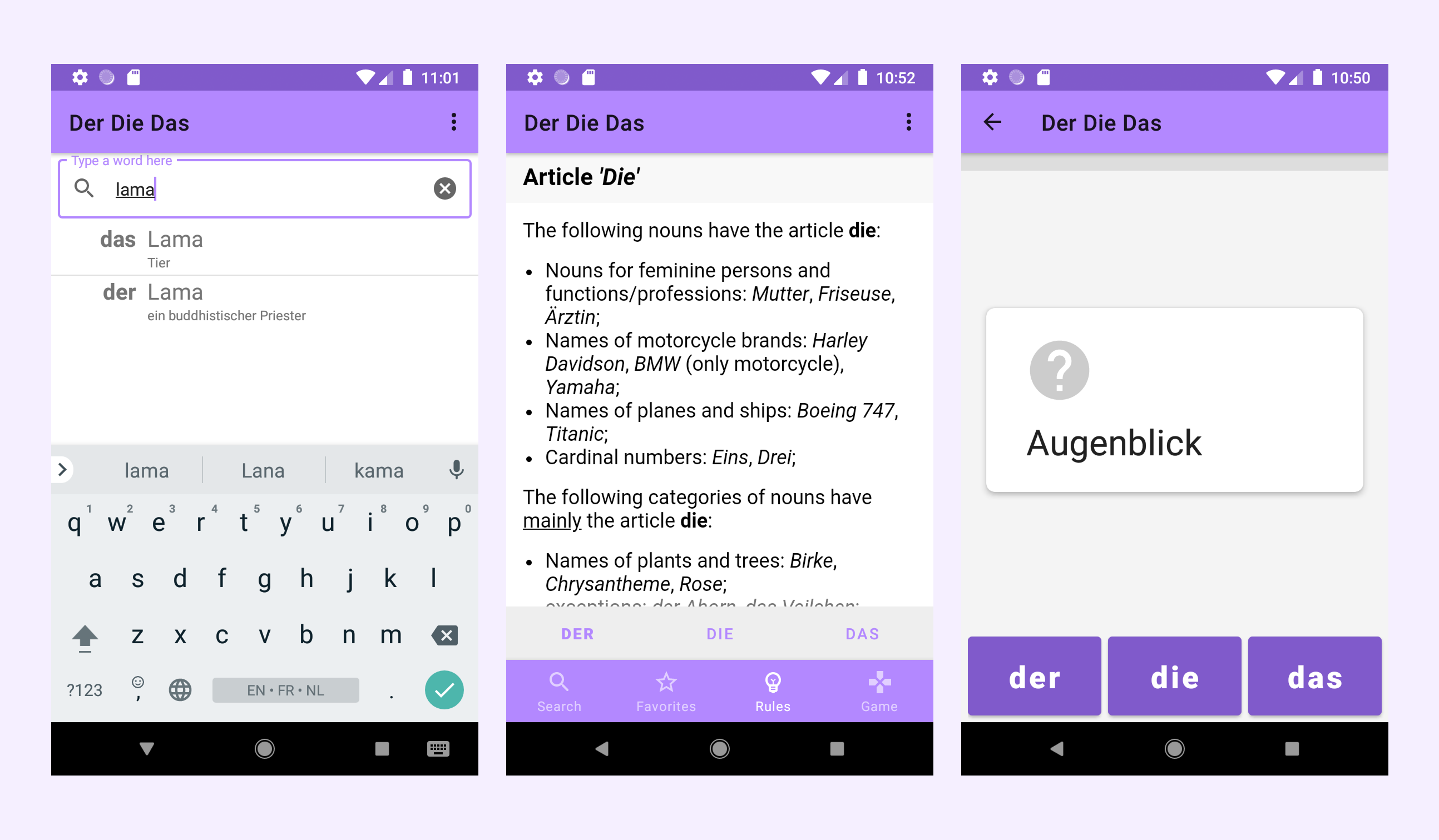
German's three genders trip up almost every learner, and this free app is built to solve exactly that problem. Type in a word and it shows you the gender and article, with a simple game to help the trickier ones stick, across a dictionary of roughly 17,000 nouns.
Our take: This is the app you'll open mid-sentence. Unsure whether it's der, die, or das Joghurt? Two taps and you have your answer (it's der, usually). It does one small thing and does it instantly, which is exactly what you want from a reference tool. Every German learner's phone should have it sitting next to a proper dictionary.
Price (2026): Free.
Good for: A fast, focused fix for one of German's most frustrating quirks.
Limitation: It's a reference tool, not a full course, so use it alongside broader study.
Apps vs. live classes: Which do you actually need?
Think of apps as your daily habit, and classes as your accountability. Apps handle quick vocabulary reps or a chance to chat with a language partner on your own schedule. What they can't do is catch a mistake and explain, in real time, why "Ich habe zwanzig Jahre alt" doesn't work.


Learn German from certified teachers and app-based practice
Try for freeYou don’t have to choose one. Keep the app for the daily 10 minutes; that’s genuinely what it’s good at. Add two live classes a week with Lingoda and the vocabulary you’ve been collecting finally comes out of your mouth, with someone there to correct it.
The ACTFL Proficiency Guidelines, the standard used across US language education, treat interpersonal speaking, real back-and-forth conversation, as a distinct skill from interpretive listening or reading, one that only develops through genuine two-way interaction.
That's the gap live classes fill. With Lingoda, you get live classes with certified teachers who correct your mistakes in real time, a structured curriculum built around your level, and smart exercises connected to each lesson, so what you review between classes actually shows up in the next one. Here it straight from our student:
"Great language courses, nice teachers, flexible hours, useful content, and good practice possibilities on the app. I'm glad I chose Lingoda. Good progress for me: the best part is that you actually talk in your target language."
FAQs
There's no single best app; it depends on your goal. Duolingo is the easiest way to build a daily habit, Babbel and DW Learn German give you clearer grammar structure, and Pimsleur and Tandem focus on speaking. Most learners get the best results combining two or three apps that cover different skills.
What is the best free app to learn German?
DW Learn German (Nicos Weg) is the strongest fully free option, with a real A1–B1 course structure. Duolingo, Memrise, Tandem, and Der Die Das also offer solid free versions, though some limit daily use or advanced features.
Is Duolingo good for learning German?
Duolingo is great for building vocabulary and a daily study habit, especially at the beginner level. It's less strong on grammar explanations, so many learners pair it with an app like Babbel or DW Learn German.
Is Babbel or Duolingo better for German?
Duolingo is more game-like and better for daily practice and vocabulary. Babbel leans into structured grammar lessons, which some learners prefer past the very basics. Many people use both, rather than choosing one over the other.
What is the best app to learn German for beginners?
Duolingo and DW Learn German are both strong starting points, thanks to their structured, level-based courses and low, or no, cost.
Can you become fluent with an app?
Apps are great for building vocabulary, grammar familiarity, and listening skills, but most learners plateau around A2–B1 without real conversation practice. Speaking with native speakers or in live classes fills the gap self-study apps can't.
How long does it take to learn German?
It depends on your starting point and how often you practice, but many learners reach a conversational A2–B1 level in six months to a year of consistent study, faster with regular speaking practice.
Which German app should you actually download?
Start with one app that matches your main goal: Duolingo or DW Learn German if you're just starting out, Babbel if you want grammar explained clearly, Pimsleur or Tandem if speaking is the priority. Most learners end up combining two or three, since no single app covers vocabulary, grammar, and conversation equally well.
That said, apps have a well-known ceiling. Ask around any language-learning community and you'll hear the same thing: self-study gets you to A2, but real fluency takes real conversation, with feedback from someone who can catch your mistakes and push you further. If you've hit that wall, live classes with a certified teacher are built to close exactly that gap.
Learn German from certified teachers and app-based practice
Try for freeRiya Dosani
Riya is a copywriter swapping between punchy campaign lines and long-form blog posts. She escaped the Mumbai heat to settle in Berlin, where she now writes for Lingoda, building a community for language learners. When she's not writing, you'll find her hunting down mid-century modern finds, knitting, or collecting graphic novels.