Living in Germany in 2026: Key legal and lifestyle changes


by Lea Hauke
Updated on December 18, 2025
Living abroad always comes with a special kind of uncertainty, especially when rules, costs, and permits shift faster than you can keep up. As 2026 approaches, Germany has confirmed several updates that will directly affect expats, from immigration and work to taxes, housing, and transport.
This guide cuts through the noise and focuses only on what’s confirmed, so you don’t have to guess, worry, or dig through rumours. Whether you’re building long-term plans or simply trying to feel more settled, knowing what’s ahead can make things feel a little more manageable.
- 2026 Immigration and residency updates for expats
- Changes to work, wages and taxes in 2026
- What’s new in housing, transport and everyday costs
2026 Immigration and residency updates for expats
There are several changes in 2026 that will directly affect immigration thresholds and residency. Here’s the most important information you need to know. These are the changes that could shape your work options, your long-term plans, and even your ability to feel at home in Germany.
Updates to the Skilled Immigration Act
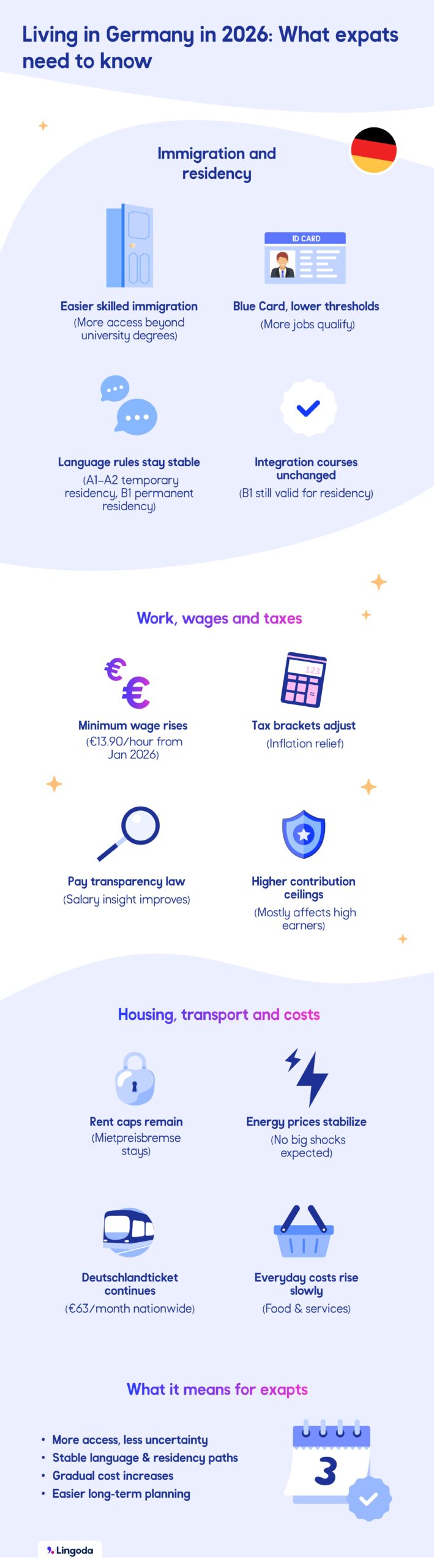
Germany’s updated Skilled Immigration Act continues to broaden access to the labor market in 2026 for people with vocational training and strong practical experience, not just university degrees. One of the biggest shifts is flexibility: your job no longer has to perfectly match your original qualification (except for regulated professions).
The Auswärtige Amt (Germany’s immigration office) states that [with the update], “Germany offers interested workers, especially those in the IT, care and skilled craft sectors, a wide range of possibilities to build a good life.”
Recognition has also become more accessible. Through a recognition partnership, you can now enter Germany, start working right away, and complete the formal recognition process after arrival. The current language requirement for this route is A2 German, making it a more realistic option for many newcomers. Overall, the law is clearly designed to lower barriers and speed up access to qualified work.
Blue Card Changes
If you’ve been waiting for an easier way to work in Germany, 2026 may finally be the year it becomes possible.
The EU Blue Card has become more accessible thanks to lower salary thresholds and broader eligibility. In shortage occupations and for new labor market entrants, the minimum annual gross salary is now €43,759.80 (45.3% of the pension contribution assessment ceiling). For all other professions, the threshold is €48,300 (50%). This finally opens the door for thousands of people who were previously just out of reach of the Blue Card system.
As Germany is experiencing a shortage of skilled workers in several sectors, Blue Card changes were almost mandatory, as foreign minister Annalena Baerbock stated in an article for the FAZ: “There are currently 1.7 million job vacancies in Germany, with staff shortages in 200 occupations where it is very difficult to fill jobs. That is why the German Government has made securing skilled workers one of its priorities.”
Eligibility has also expanded beyond traditional academic paths. IT specialists can now qualify without a university degree if they can prove several years of relevant work experience and meet the lower salary threshold. At the same time, the list of recognised shortage occupations has grown to include roles in healthcare, education, management and engineering.
There’s also more freedom of movement: if you already hold a Blue Card from another EU country, switching to Germany is now significantly easier.
CEFR and language requirements for Residency
If you’ve ever felt unsure about which German language level you actually need for your next residence step, you’re not alone. The good news for 2026 is that the core language requirements remain unchanged. BAMF has no planned surprise increases.
- For temporary residence permits, the required level is usually A1 or A2, depending on your purpose of stay. For example, spouses joining a partner typically need A1 German before arrival.
- For permanent residence (Niederlassungserlaubnis), you’ll generally need B1 German, along with basic knowledge of Germany’s legal and social system.
- For family reunification, the standard rule for spouses remains A1.
As of now, BAMF has not announced any new higher language thresholds for 2026. That means if you’re currently working toward A2 or B1, you’re still on the right track. For many expats, that stability alone is a huge relief. Official certificates from integration courses and recognised language exams continue to be accepted for all of these residence steps.
BAMF Integration Course Updates
For most expats, participation in an integration course requires an official eligibility certificate (Berechtigungsschein). Once you receive this, you can choose a course provider near you using BAMF’s online search tool, and the school will help place you in a suitable course.
The structure itself stays familiar and consists of a language course plus an orientation course, usually totaling around 700 hours. Cost-wise, participants currently pay €2.29 per lesson unit, which adds up to about €1,603 for a standard course. You don’t have to pay this upfront. It’s billed in sections. If you receive social benefits or are in a difficult financial situation, you can apply for a full exemption, and in some cases, even receive travel cost support.
If you complete the final test within the required time frame, you may also be eligible for a 50% refund of your course fees. A B1 certificate from an integration course remains a recognised pathway to permanent residency in 2026.
Changes to work, wages and taxes in 2026
Although taxes might not be everyone’s favorite topic, it’s still important to stay up to date. Let’s take a look at the changes for minimum wages, income tax brackets and the new EU pay transparency directive that will come into place in 2026.
Minimum wage increase
Germany’s statutory minimum wage will rise to €13.90 per hour on 1 January 2026. This increase follows a binding recommendation from the independent Minimum Wage Commission and is expected to affect around 6.6 million workers, especially in lower-income and service-sector roles.
If you work in hospitality, retail, cleaning, care, or similar fields, this change could directly increase your monthly income. For many expats in entry-level or part-time roles, it’s a small but meaningful step toward better financial stability.
Income tax bracket adjustments
As part of the 2026 federal budget, Germany will adjust its income tax thresholds to reflect inflation and rising living costs. The goal is to prevent “cold progression,” where pay increases are eaten up by higher tax rates.
For most employed expats, especially those on middle incomes, this could mean slightly more net pay each month without any change to their gross salary. The relief won’t be dramatic, but it’s a welcome correction at a time when everyday expenses remain high.
EU Pay Transparency Directive Implementation
By 7 June 2026, Germany is required to implement the EU Pay Transparency Directive, which will significantly strengthen employees’ rights around salary transparency. Once the new rules take effect, workers will be able to request information about pay levels and salary ranges for comparable roles inside their company.
For expats, this could finally make it easier to understand whether you’re being paid fairly — something that can be hard to judge in a new country.. The aim is to reduce unjustified pay gaps and make compensation structures fairer and more transparent. While the German law is still being finalized, the direction aims for more openness, more accountability, and better access to information for employees.
Social Contributions and Pension Changes
There is no major pension reform confirmed for 2026, but social security contribution limits will increase as part of the regular annual adjustment to rising wages. From January 2026, higher earners will pay contributions on a larger portion of their salary. However, for most employees, nothing changes.
For example, the health insurance contribution ceiling will rise to €69,750 per year, and the pension contribution ceiling to €101,400 per year. If you earn below these thresholds, your contributions stay the same. If you earn above them, your monthly deductions will increase slightly.
For expats planning to stay in Germany long-term, these contributions matter because they directly affect health coverage, pension entitlement, and unemployment benefits. Even small annual changes can make a difference over time, so it’s worth keeping an eye on them.
What this means for self-employed expats
If you’re self-employed in Germany, the 2026 changes affect you a little differently. The minimum wage increase does not apply to freelancers, since it only covers employed workers. However, tax bracket adjustments and pay transparency rules can still influence the market rates clients are willing to pay in industries where salaries become more visible.
When it comes to health insurance and pensions, freelancers continue to manage these privately. If you’re voluntarily insured in the public system, rising contribution thresholds may increase your monthly costs in 2026. For long-term planning, it’s worth reviewing your health insurance, pension setup, and tax strategy regularly with professional advice.
What’s new in housing, transport and everyday costs
If there’s one topic that affects daily life the most, it’s the cost of living. In 2026, the picture is mixed: Some protections are staying in place, some prices continue to rise gradually, and a few areas are becoming more predictable again.
Housing: rent regulation remains in force
Germany’s key rent-control tools, including the “Mietpreisbremse” (rent cap) in tight housing markets, remain in effect in 2026. This doesn’t freeze rents completely, but it continues to limit how much landlords can charge for new contracts in regulated cities.
As Sonja Eichwede from the SPD (Social Democratic Party in Germany) highlighted: „Wohnen ist ein Grundrecht, Wohnen ist kein Luxusgut“ (Housing is a fundamental right, not a luxury).
For many expats, this means more legal protection when moving, even though finding an apartment is still competitive in most urban areas.
Energy prices are now far more stable than during the crisis years, but heating and electricity costs remain higher than pre-2022 levels. Many households should expect steadier bills rather than big drops.
Transport: Deutschlandticket continues
The Deutschlandticket will continue in 2026, but at a higher monthly price of €63. While the nationwide validity remains unchanged, meaning you can still use it on local and regional public transport across Germany, the price increase reflects rising operating and subsidy costs.
For expats who commute regularly by bus, tram, or regional train, the ticket still offers strong overall value, especially compared to local monthly passes in larger cities. Even with the increase, it remains one of the simplest and most cost-effective ways to stay mobile across Germany without worrying about zones or individual networks.
For many people, it still represents a kind of freedom: the ability to explore, commute, and move through Germany without stress.
Everyday costs: food and services
The cost of food and everyday services in Germany is expected to rise slightly again in 2026, mainly due to higher wages, energy costs, and updated supplier pricing. While inflation has slowed compared to previous years, essentials like groceries, dining out, haircuts, cleaning services, and repairs are still gradually becoming more expensive.
For expats, this likely means small but noticeable increases in monthly living costs, especially if you’re living in a larger city. Supermarket prices may continue to fluctuate by product category, while services tied to minimum wage, like hospitality or personal care, are most directly affected by the 2026 wage increase. The good news is that sharp price spikes are not currently expected, making budgeting more predictable than in recent years.
FAQs
What are the new minimum wage rules in Germany in 2026?
From 1 January 2026, Germany’s statutory minimum wage increases to €13.90 per hour. This affects around 6.6 million workers, particularly in service and lower-income sectors such as hospitality, retail, and care work.
Do I need B1 German for a permanent residence permit in 2026?
The standard requirement for permanent residence (Niederlassungserlaubnis) in 2026 remains B1 German, along with integration knowledge. No higher language threshold has been announced by BAMF for permanent residency applications.
Has Germany updated tax brackets for 2026?
Income tax thresholds will be adjusted in 2026 to reflect inflation and rising living costs. This is meant to prevent “cold progression” and may result in slightly higher net income for employed expats, especially on middle salaries.
What are the new driving licence rules for expats in 2026?
Germany will introduce digital driving licences via an official smartphone app in late 2026. Paper licences issued between 1999–2001 must be exchanged by January 19, 2026. Theory exams and training will also become cheaper and more digital.
Will tenant rights or rent caps change in Germany in 2026?
Germany’s key rent control tool, the Mietpreisbremse, will remain in force in 2026. Tenant protections stay in place, limiting rent increases in high-demand areas, although competition for housing in major cities remains strong.
Looking ahead: How to navigate life in Germany in 2026
The confirmed changes for 2026 won’t change everything at once, but they will shape how secure and affordable life in Germany feels for many expats. From residency and language rules to wages, transport, and living costs, these updates touch everyday decisions.
If you’re working toward permanent residence, now is the time to keep progressing with your German and gather the documents you’ll need. If you’re employed, check how the minimum wage increase, tax adjustments, or pay transparency rules might affect your income. And if you’re managing rising living costs, reviewing your transport options, housing rights, and monthly budget can help you stay in control.
Living in Germany will always involve some bureaucracy, but 2026 brings more stability than surprise. By understanding what’s confirmed and acting early, you can reduce uncertainty and focus less on paperwork — and more on building a life that feels secure, balanced, and sustainable in Germany.




Lea Hauke
Lea is a writer and translator for English and German and lives in Austria. Her love for literature is only met by her enthusiasm for music. During her studies in Berlin, she started writing for different music magazines and was the singer and drummer of a punk band. When she completed her Masters in English Literature, she moved to Tyrol, where she started her own business. Since then she has made it her mission to help others to find the right words for their ideas and projects. You can find more information about her on her website and on LinkedIn.