The German stare: A survival guide for expats
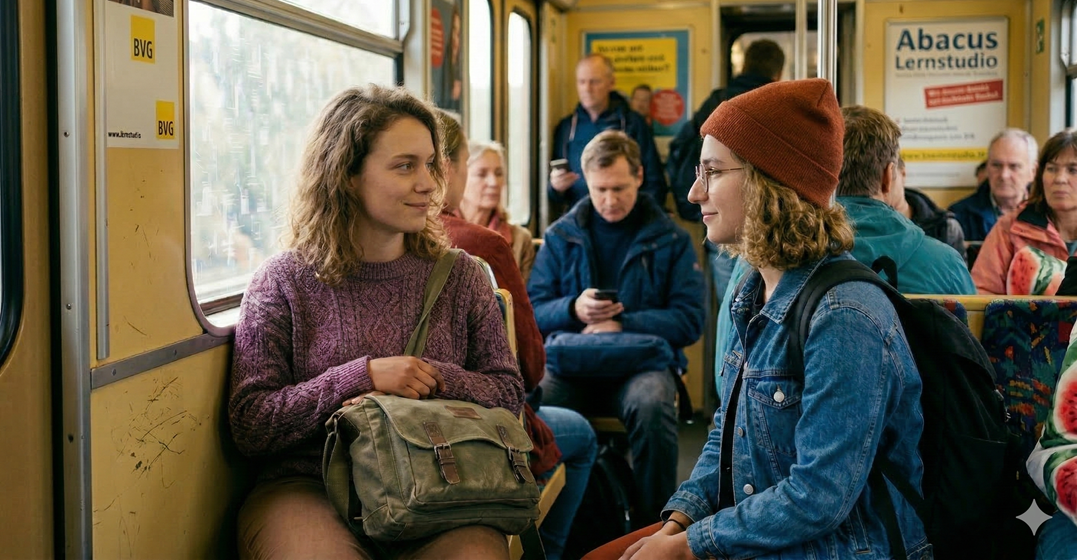
If you have recently moved to Berlin, Munich, or even a small village in the Black Forest, you have likely experienced it: the unblinking, prolonged gaze of a stranger on the U-Bahn or at the supermarket. In many cultures, this level of eye contact is a prelude to a confrontation or a sign of intense attraction. In Germany, however, it is simply a part of daily life.

Updated on March 10, 2026
The German stare often leaves newcomers feeling judged, self-conscious, or even a bit paranoid. You might check your reflection to see if you have spinach in your teeth or wonder if your outfit is somehow offensive. Rest assured, you are likely doing nothing wrong. By the end of this guide, you will understand the difference between a neutral look and a "correctional stare," helping you integrate faster into your new home.
- What is the German stare?
- Why do Germans stare? The cultural explanation
- 5 common situations where you'll face the "gaze"
- How to respond like a local
- When the German stare actually means you're doing something wrong
What is the German stare?
To understand social norms in Germany, you first need to look at "staring" through a different lens. While many expats perceive the German stare as a glare, locals view it as "open looking." In many countries, people practice "polite inattention" as the act of looking away to give others a sense of privacy in public spaces. In Germany, this social shield does not exist in the same way.
When a German looks at you, they are rarely judging you. Instead, think of it as a data-gathering exercise. Because of significant cultural differences regarding personal space and privacy, Germans feel comfortable processing their environment by observing the people in it. According to many discussions on platforms like Reddit, expats often feel they have "something on their face" when they first encounter this gaze. In reality, you are simply a part of the landscape that the observer is calmly taking in.
Why do Germans stare? The cultural explanation
The root of this behavior lies in the German values of honesty, direct communication and the social contract. In Germany, maintaining eye contact is a sign of transparency. The logic is simple: "I am looking at you because I have nothing to hide, and I expect the same from you."
Honesty over politeness: The "nothing to hide" rule
In many cultures, looking away is a way to avoid "intruding" on someone. However, Germans often view looking away as shifty, suspicious, or even insincere. To look someone in the eye, even a stranger, is a signal of transparency. By holding a gaze, a German is essentially saying, "I am an honest person with nothing to hide, and I assume the same of you." It is less about being friendly and more about establishing mutual trust in a split second.
The absence of the "social shield": Public vs. private space
While a direct gaze might feel like it invades a "privacy bubble," Germans define that bubble differently. In many parts of the world, people carry a "social shield" into public, expecting others to pretend they aren't there. In Germany, privacy is what happens behind a closed front door. Once someone steps onto the sidewalk, they are in a shared space. To a local, observing others isn't an "intrusion" because everyone is already in the public domain; it’s simply a neutral acknowledgement of the environment.
Observation as respect: Listening with your eyes
In the German workplace and social life, eye contact is a functional tool for Sachlichkeit (objectivity). If someone is not looking at the person they are interacting with, they are not truly "with" them. This "active looking" signifies that the observer is giving the situation their full attention and respect. This habit spills over into the streets: when a German looks at another person, they aren't necessarily judging them; they are "listening" to the public space and acknowledging the other person's presence as a fellow participant in the day.
5 common situations where you'll face the "gaze"
You are most likely to encounter the German stare in these specific scenarios. Recognizing them is the first step toward feeling like a local:
1. Public transport (U-Bahn/S-Bahn)
The most common place to experience the stare is while commuting. A passenger sitting across from you may maintain eye contact for the entire journey. They aren't waiting for a conversation; they are simply passing the time by observing their surroundings. In a crowded city like Berlin, people-watching is the primary form of entertainment.
2. The checkout line
As you pack your groceries at the German supermarket, the person behind you might watch every move. While it’s partly an 'efficiency check' to ensure the queue keeps its rhythm, there’s often a touch of genuine judgment involved. In a culture that prizes a smooth-running system, they’re likely critiquing your speed, your spatial awareness, your technique for utilizing those reusable bags and even your choice of snacks.
3. The "Prost" rule
When clinking glasses, eye contact is not just a suggestion; it is mandatory. Failing to look your partner in the eye is a major breach of etiquette. According to local superstition, failing to maintain this gaze brings seven years of bad luck (specifically in the bedroom), so you will find everyone at the table staring quite intently until the glasses have touched.
4. Waiting rooms
Whether at the Bürgeramt (registration office) or the doctor, waiting rooms are prime territory for neutral observation. With no "social shield" to hide behind, Germans will use the quiet time to observe those around them. It is a neutral acknowledgement of the people sharing the space.
5. Crossing the street
If you are standing at a crosswalk, pedestrians and drivers will watch you closely. They are often checking to ensure everyone is following the Ampel (traffic light) rules. If you even look like you might cross on a red light, the stare will quickly transition from neutral observation to a "correctional" look.
How to respond like a local
Learning how to respond to the stare is a key part of your integration. You don't need to feel intimidated; you just need to choose your reaction based on the situation:
- Option A: Do nothing. This is what most locals do. Acknowledge the gaze, then simply continue your day. You don't owe the observer a smile or a conversation.
- Option B (The professional): If the gaze feels a bit too long, a brief, neutral nod is the perfect way to acknowledge the person without inviting a full dialogue.
- Option C (The flirt): If you are in a social setting like a bar and the look feels intentional, a small smile can be a way to test the waters.
Whatever you do, avoid "staring back" aggressively as a challenge. In some cultures, this is a "What are you looking at?" confrontation, but in Germany, it might just start a very long, very silent staring contest that you are likely to lose.
When the German stare actually means you're doing something wrong
While most stares are neutral, there is such a thing as the "Correctional Stare." This happens when someone believes you are violating a social rule. If the gaze comes with a slight frown or a tilted head, check if you are doing any of the following:
- Talking too loudly: If you have a loud phone conversation on the train, you will feel the weight of the entire carriage’s gaze.
- Bike lane violations: Standing in the red-painted bike lane is a guaranteed way to receive a high-speed stare from a cyclist.
- Recycling errors: Putting glass in the plastic bin? A neighbor might watch from their window to ensure you uphold the social contract of German recycling.
- Jaywalking: Crossing on a red man, especially if children are present, will earn you a look of deep disapproval.
Is the German stare considered rude?
No. In Germany, avoiding eye contact is often seen as more suspicious or rude than holding it. Directness is a sign of honesty and reliability.
How long does a typical German stare last?
A typical gaze can last around 4–5 seconds. This is roughly double the "comfort zone" of many English speakers, which is why it feels so intense when you first arrive.
Winning the staring contest: Your new life in Germany
The German stare is one of the first cultural hurdles you will face, but once you understand it is about observation rather than judgment, it becomes much easier to handle. Now that you know how to handle the gaze, what are you waiting for? At Lingoda, you will learn about German culture and social nuances while building the skills to speak confidently in any situation. If you want to go a step further, Lingoda can help you learn German with live classes and personalized feedback from certified, native-level teachers who provide real-world insights into the "silent language" of Germany!

Learn German with Lingoda
How it works

We use AI tools to support idea generation and drafting. Every article is edited by our editorial team to ensure accuracy, clarity, and quality.
Jessica Schnase
Hailing from Germany, Jessica has swapped pretzels for scones and now lives in the UK where she works as the Senior Content Manager at Lingoda. She worked in various industries where she honed her skills in content marketing. She holds degrees in Media Studies and English Literature having studied in several countries. She uses yoga practice and singing in a choir to switch off from everyday life.