German culture: a guide to traditions, values and social norms
German culture is often reduced to a handful of well-worn images: beer steins, efficiency, punctuality. But if you’ve recently moved to Germany, or you’re preparing to, you already know that the reality is far more layered than any stereotype. Understanding German culture isn’t about memorizing a list of dos and don’ts. It’s about grasping the underlying logic of how German society works — and why it works that way.

Updated on April 10, 2026
This guide is designed for professionals and students who need more than surface-level knowledge. Whether you're navigating a new workplace, building a social life, or simply trying to feel less like an outsider, cultural fluency is just as important as language fluency. Here, we'll map the key pillars of German culture: regional identity, social trust, communication norms, seasonal rhythms, food rituals and intellectual life.
- Regional diversity and the decentralised German identity
- Communication styles: directness as a cultural value
- Social infrastructure and the high-trust, rules-based society
- Traditions and the seasonal rhythm of life
- Culinary culture as social ritual
- Arts, intellectual life and the Dichter und Denker tradition
- FAQs
Regional diversity and the decentralised German identity
One of the most common mistakes newcomers make is treating Germany as a single, unified culture. It isn't. Germany is a federation of 16 states (Bundesländer), each with its own history, dialect and distinct personality. The modern nation-state is relatively young, but the regional identities are ancient. And understanding this decentralisation is one of the most practical things you can do as a newcomer.
How federalism shapes daily life
Many of the things that affect your daily life in Germany are Ländersache (state matters). This is why there's no single "German" rule for a surprising number of common situations.
Public holidays vary by state: Bavaria observes up to 13 per year, while Berlin gets ten, reflecting the Catholic-Protestant divide across regions. School systems, including curricula and holiday dates, differ entirely between states: moving a child from Hamburg to Stuttgart can feel like switching countries. Even the efficiency of your local Bürgeramt or Ausländerbehörde (Foreigners' Office) depends heavily on the administrative culture of that specific city.
For fresh migrants especially, this matters. The experience of settling into Munich is genuinely different from settling into Hamburg or Düsseldorf. What works socially in one region may fall flat in another.
Dialects as regional identity markers
While everyone in a professional setting speaks Hochdeutsch (Standard German), regional German dialects remain a powerful marker of social belonging. Bairisch (Bavarian) can sound like a different language to the untrained ear. Plattdeutsch (Low German), spoken in the north, carries a maritime, understated rhythm. Schwäbisch (Swabian) is central to the identity of the industrious south-west. You don't need to master these dialects, but recognising their value matters.

Learn German with Lingoda
How it works

North vs. South and the East/West divide
The cultural gap between northern and southern Germany is real and rooted in history. The Protestant North, shaped by Prussian values of restraint and civic discipline, tends toward a more reserved, understated social style. The Catholic South, particularly Bavaria, leans toward tradition, community ritual and a warmer, if more insular, social culture.
Germany's three major urban hubs also have distinct personalities worth knowing before you arrive. Berlin is globalised, secular and somewhat chaotic, known as the least "traditionally German" of the major cities. Munich sits at the intersection of high-tech industry and traditional folklore: clean, expensive and deeply rooted in Bavarian identity. Hamburg, a port city with an Anglophile streak, values reliability and understatement. People here are known as hanseatisch, meaning reserved but trustworthy.
Any honest account of German culture also has to acknowledge the Mauer im Kopf (the "wall in the mind") that lingers decades after reunification. While younger generations are more integrated, differences in political attitudes, religious affiliation and social structures between the former East and West remain. Recognising that Leipzig or Dresden carry a different historical weight than Cologne or Frankfurt is part of genuine cultural fluency.
Communication styles: directness as a cultural value
If you've had a German colleague tell you bluntly that your presentation needed work, or a neighbour point out that you're sorting your recycling incorrectly, you may have experienced what feels like startling directness. In German culture, this isn't rudeness, it's respect.
Directness is a cultural value rooted in the belief that clarity serves everyone better than ambiguity. Germans generally skip smalltalk and prefer honest, efficient communication over social lubrication. This extends to everyday interactions: don't expect chitchats in lifts, on public transport or in waiting rooms. The silence isn't coldness, it's simply the norm.
Social infrastructure and the high-trust, rules-based society
Perhaps the most important thing to understand about German culture is that it operates on a high-trust model. The system of public transport, recycling infrastructure, road safety and noise regulations functions because everyone is expected to participate in it. This isn't just politeness but the foundation of how daily life is organised.
The green light mentality
Jaywalking is the simplest illustration. In many countries, crossing on red when no cars are coming is unremarkable. In Germany, it attracts visible disapproval; not because of fear of a fine, but because the system depends on predictability. Children are watching. Other pedestrians are calibrating their behaviour based on yours. The social contract is being actively maintained.
This "green light mentality" extends across German public life. It explains why noise ordinances are taken seriously, why recycling rules are followed with precision and why arriving late feels like a more significant breach than it might elsewhere. The rules aren't bureaucratic impositions: they're the infrastructure that makes a high-density society function with relatively low friction.
Social correction in public
One of the more jarring experiences for many newcomers is being corrected by a stranger. A neighbour tells you you're putting plastic in the paper bin. Someone on the street points out that you've cycled through a red light. In most cultures, this kind of unsolicited feedback would feel intrusive or aggressive.
In Germany, it's the system self-regulating. Being corrected isn't a personal attack but rather an invitation to participate correctly in the shared social infrastructure. Responding with a calm acknowledgment ("Danke, I didn't know that") is almost always received well. Defensiveness tends to land badly.
Environmental rules as cultural expression
Pfand (the bottle deposit system), Mülltrennung (waste separation), Ruhezeiten (quiet hours) aren't quirky local rules to be tolerated. They're expressions of a deep cultural value: collective responsibility for shared space and resources.
Germany has one of the most sophisticated waste separation systems in the world, and compliance rates are genuinely high — not because of heavy enforcement but because environmental consciousness is culturally embedded. For newcomers, learning the recycling system isn't just practical. It's one of the fastest ways to signal that you're engaging seriously with the culture you've joined.
Traditions and the seasonal rhythm of life
German cultural life follows a strong seasonal and weekly rhythm. Understanding that rhythm, and what it means socially, is one of the more practical forms of cultural knowledge for anyone integrating into German life.
Sunday as a cultural institution
Ruhetag (the day of rest) is not just a legal requirement in Germany. It's a cultural value. Shops close. Construction stops. Noise levels drop noticeably. For migrants from countries where Sunday is a normal shopping or errand day, this requires genuine adjustment.
Rest is treated as a collective right in Germany, not a personal preference. Disturbing the Sunday quiet by drilling, hosting a loud gathering or doing laundry at the wrong time isn't just inconsiderate. It's a breach of the social contract. Once you understand Ruhetag as a cultural value rather than an inconvenient restriction, it becomes much easier to respect and even appreciate.
Regional festival variation
Germany's festival calendar is rich but, consistent with everything else, varies significantly by region. Karneval in the Rhineland (particularly Cologne and Düsseldorf) is a full-scale five-day street festival rooted in Catholic tradition. Fasching in Bavaria is its southern equivalent, with its own distinct customs. Berlin, by contrast, has no equivalent tradition and largely ignores both.
Weihnachtsmärkte (Christmas markets) are one of the few near-universal cultural moments — found across almost every German city and town from late November, they represent one of the warmest and most accessible entry points into German social life for newcomers. Beyond that, German traditions vary so much by region that they deserve their own deep dive.
Culinary culture as social ritual
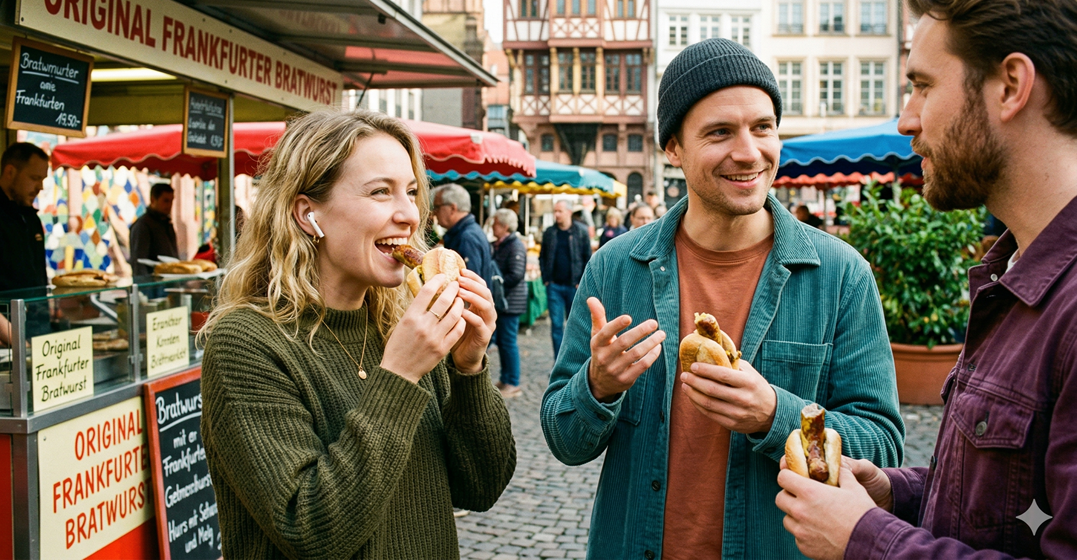
Germany's food culture runs deep: from Bratwurst to Schwarzwälder Kirschtorte traditional German food is a topic in its own right. What's less often discussed is food as a social ritual. The when and with whom of eating reveals as much about German culture as the food itself.
Abendbrot: the cold evening meal
For many newcomers, the German tradition of Abendbrot (literally "evening bread," a cold meal of bread, cheese, cold cuts and spreads) comes as a surprise. In cultures where a hot dinner is the main social meal of the day, this feels sparse or even austere.
The logic is consistent with broader German values: the main cooked meal is typically eaten at midday (Mittagessen), making the evening a time for rest and simple nourishment rather than culinary effort. Understanding Abendbrot as a deliberate cultural choice, not a failure of imagination, makes it easier to settle into the rhythm of a German household.
Kaffee und Kuchen
The mid-afternoon ritual of coffee and cake (Kaffee und Kuchen) is a genuine social institution, particularly on Sundays and at family gatherings. Think of it as the German equivalent of British afternoon tea — a structured pause in the day that creates space for conversation and connection. If you're invited to someone's home for Kaffee und Kuchen, it's a meaningful gesture of welcome, not a casual afterthought.
The Bäckerei as community infrastructure
The neighbourhood bakery (Bäckerei) occupies a social role in German life that goes well beyond selling delicious German bread. It's a daily touchpoint, a source of regional identity (bread varieties differ sharply between regions; there are over 3,000 registered varieties in Germany) and one of the few public spaces where brief, warm interaction with strangers is culturally normal. A regular morning visit to your local Bäckerei is, in its quiet way, one of the most effective integration strategies available to a newcomer.
Arts, intellectual life and the Dichter und Denker tradition
Germany's self-description as a nation of Dichter und Denker ( "poets and thinkers") is not historical vanity. While Goethe, Schiller, Kant and Beethoven belong to the past, their legacy actively shapes how modern Germans communicate, argue and value information.
The tradition shows up in professional life in a specific way. In many corporate cultures, meetings are shaped by a desire to keep the mood positive and avoid direct confrontation. In Germany, the Dichter und Denker tradition manifests as Sachlichkeit (objectivity). A German colleague who challenges your data or points out a flaw in your reasoning during a meeting isn't being hostile. In the German intellectual tradition, the pursuit of the right answer is a shared goal, and challenging an idea is a sign that it's worth taking seriously.
There's also a specific concept every expat should know: Bildung. It translates roughly as "education," but it implies a lifelong pursuit of cultural and intellectual self-improvement which is not just formal qualifications. This is part of why Germany supports over 6,500 museums and a vast network of subsidised theatres and opera houses. Being able to discuss a recent exhibition or hold your own in a conversation about 20th-century German history carries genuine social currency in professional circles here.
The Bauhaus movement is another expression of this intellectual heritage: the idea that form should follow function, that clarity and utility matter more than decoration. When a German colleague pushes for a cleaner process or a more logical structure, they're operating within a framework that values precision as a form of respect. Leaning into this by presenting not just a solution but the reasoning behind it is one of the faster ways to build credibility in a German professional environment.
And it explains one more thing: why Germans often skip small talk and move directly into substantive topics like politics, current events or philosophy. If you have ten minutes with someone, why spend it on the weather? Don't be put off if a new acquaintance asks your opinion on something complex early on: it's an invitation, not a test.
What is German culture known for?
German culture is known for its regional decentralisation, strong work-life boundaries (Feierabend), intellectual heritage (Dichter und Denker) and the concept of Ordnung: a collective commitment to order and reliability. Environmental consciousness and a high-trust, rules-based approach to social life are also defining characteristics.
What are German values?
From punctuality and directness to environmental responsibility and privacy, German values run deeper than most stereotypes suggest.
What are Germans like?
German people tend to be reserved initially, prioritising honesty over small talk, but loyal and genuinely warm once trust is established. Behaviour also varies significantly by region: Bavaria and the Rhineland feel culturally distinct from Berlin or Hamburg, so your experience will depend partly on where you are.
What are the dos and don'ts in Germany?
Do follow traffic signals even when no cars are coming, separate your recycling carefully, keep noise levels low on Sundays and arrive on time, or early. Don't engage in unsolicited small talk in transitional spaces like lifts or public transport, mistake directness for hostility, or underestimate how seriously Germans take environmental and noise rules.
German culture as a system
German culture makes a lot more sense once you stop seeing it as a collection of quirks and start seeing it as a system. Regional identity, high-trust social infrastructure, direct communication, seasonal rhythms, food rituals and intellectual life all connect to the same underlying values: reliability, collective responsibility and a genuine respect for the people around you.
And if you want to build your language skills alongside your cultural fluency, Lingoda's German classes put you in small groups with native-level teachers who live the culture they teach.
Learn German with Lingoda
How it worksWe use AI tools to support idea generation and drafting. Every article is edited by our editorial team to ensure accuracy, clarity, and quality.
Jessica Schnase
Hailing from Germany, Jessica has swapped pretzels for scones and now lives in the UK where she works as the Senior Content Manager at Lingoda. She worked in various industries where she honed her skills in content marketing. She holds degrees in Media Studies and English Literature having studied in several countries. She uses yoga practice and singing in a choir to switch off from everyday life.