2025’s language learning lessons — And how to learn smarter in 2026
It’s the last week of December. For many, it’s a time to reflect.


Updated on December 18, 2025
With notebooks half-filled and apps open on the home screen, we celebrate and question our progress. How far have we come with our language goals? 2025 changed the way many of us approached language learning — smaller habits, smarter tools, and a deeper awareness that motivation is a living thing. As adults, we don’t get gold stars. We can pat ourselves on the back for what we achieved and power our continued development. Let’s unpack what 2025 taught us — and how to carry that forward.
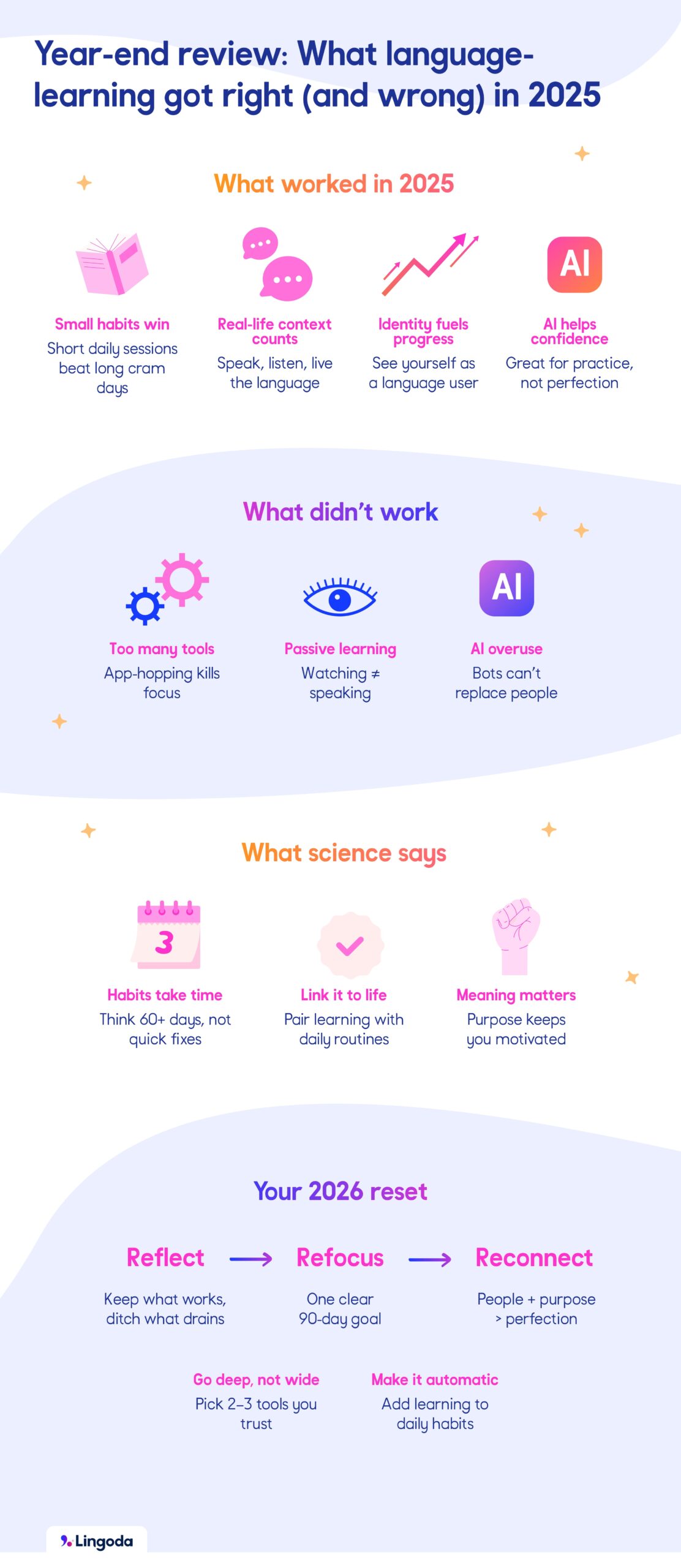
- The big wins of 2025: What we got right
- Where 2025 missed the mark
- What the data says
- Your 2026 reset: How to move forward smarter
The big wins of 2025: What we got right
What did we learn in 2025 to make language learning easier?
Consistency over intensity
The world’s best athletes don’t expect to win the Olympics by training six hours on Saturdays. It’s about consistency.
“Consistency beats intensity in adult language learning: the learner who shows up every day for 15 minutes often surpasses the one who bursts out for an hour once a week.” – Dr. Judit Kormos of the University of Lancaster.
Consistency is powerful when it comes to language learning. This past year, learners increasingly embraced short, frequent study sessions — 10–15 minutes daily rather than cramming. Habit formation research emphasizes steady work towards your language goals.
Teachers embraced micro-goals and culture-driven tasks
Language goals should not feel distant. We observed educators pivoting toward practical, culture-rich sessions — conversation, media, and context instead of grammar-first drills. Language is ultimately connecting with people. That moment of speaking and being understood is a powerful motivational tool. Research confirms that contextual learning increases enjoyment and reduces anxiety.
Motivation shifted toward identity and autonomy
“When learners feel autonomy, competence, and connection, motivation becomes self-sustaining.” — Dr. Kata Csizér, Eötvös Loránd University
Research confirms that adult learners need to feel connected to their progress. Learners who framed themselves as “someone who speaks another language” maintained progress longer.
AI for confidence, not perfection
There are new tools to help us stay focused. In 2025 learners embraced AI chat‑partners, pronunciation tools, and auto‑feedback platforms. AI tools didn’t replace human conversations, but helped build our confidence before entering the arena of real life. Studies highlight that large language models (LLMs) can serve as effective tutors—but only when complementing human instructors. The key to AI tools in 2025 was using them to experiment and feel safe making mistakes.



Where 2025 missed the mark
What did 2025 teach us to avoid going forward?
Scattered focus and “app-hopping”
There is limitless language content out there. In 2025, learners reported being overwhelmed by having too many options, apps, podcasts, and YouTube channels. Learners grabbed every new app or trend, but lacked a clear plan. That looks like a repeating cycle: “Trial tool → abandon tool → new tool.” Fragmented learning leads to a lack of clear progress and we end up learning little.
Over-reliance on passive input
Binge-watching content and endless flashcards without output is a trap. An overreliance on passive input only stalls progress. To drive motivation, many apps have incorporated “gamification.” However, gamification overload (streaks, badges, leaderboards) led some users to mindlessly tap through lessons just to avoid losing a streak. Ultimately, language learning requires productive skills like speaking and writing.
AI burnout and the illusion of automation
AI can be a useful tool, but language learners know that communication with other people is the end goal. Some students in 2025 relied heavily on bots or automated feedback, expecting fluency to follow—only to hit plateaus. Learners reported frustration with robotic or awkward phrasing, and lack of real conversation. This can create a false sense of fluency without actual communicative competence.
What the data says
What does the latest research say about language learning?
Motivation: Internal drives matter
Motivation comes from different places. Some are motivated by outside factors such as a reward or avoiding punishment (extrinsic motivation). Others are motivated simply because they enjoy doing it (intrinsic motivation). Research links learners’ motivation to a strong vision of themselves when they speak that language. Those that have a clear vision of the person they wish to become in their second language, have intrinsic motivation towards their language learning goals.
Habit formation is a long game
Ever been told to repeat something eight times and you’ll remember it forever? Or do something 21 times to build a habit? New behavioral studies reveal habit building averages 60+ days, not 21. Lower the threshold of being able to reach high repetition.
Context and environment shape success
Learners who tied language study to meaningful environments — morning walks, cooking, or journaling — built stronger recall. There is an environmental design concept for clutter that says put the laundry hamper where you take off your clothes. This may be in the bathroom, the bedroom, or the middle of the hallway. It’s rarely in the laundry room. Adjust your environment to your habits, not the other way around.
Your 2026 reset: How to move forward smarter
In 2026, avoid the same pitfalls. Try something new. Stop seeing language learning as a huge undertaking.
The 3-R framework: Reflect → Refocus → Reconnect
The 3-R framework is a simple way to approach language learning in 2026.
- Reflect: What habits worked? Which drained energy? Quit doing things that don’t work for you, specifically.
- Refocus: Choose one 90-day goal (specific, realistic, measurable). Can you handle 10 minutes per day? That adds up to 900 minutes (15 hours!).
- Reconnect: Get closer with your cousins abroad. Sign up for salsa class. Anchor your “why” — whether it’s based on identity, social ties, or community.
The 3-R approach pushes you to customize your learning process. This takes your goal from New Year’s Resolution (famously difficult) to a sustainable life choice.
Focus on depth over volume
Research tells us that we learn smarter if we focus on depth over volume. Limit your “language tech stack” to just 2–3 trusted tools. When exercising your brain, focus on solid practice, not novelty. Consistent study is better than the next new thing, which only resets momentum.
Design habits around your life
Attach your study habits to physical cues (e.g., “after my morning coffee”). If study is a part of your daily life, then it becomes a part of your daily life. And this is not an all-or-nothing high intensity kind of habit. It should be easy to slip into. Consider environmental design, which tells us that tidy, cozy, low-friction solutions sustain the strength of a habit.
Combine tech with human connection
Technology is a tool, but not a solution in itself. Use AI and digital tools for feedback and exposure, but prioritize teacher or peer interaction to maintain accountability and emotional engagement.
Your next chapter starts with what you know now
Once you know how to learn smarter, you can be assured of your growth. If you feel like you “didn’t do enough” in 2025, consider a new approach. Making a major change is hard. Making a small change is easy. If something fits in with your normal day, the consistency builds over time. And when you skip a day? Just remember what research tells us about our human capacity to learn: the best learners reflect, adjust, and continue.
Alison Maciejewski Cortez
Alison Maciejewski Cortez is Chilean-American, born and raised in California. She studied abroad in Spain, has lived in multiple countries, and now calls Mexico home. She believes that learning how to order a beer in a new language reveals a lot about local culture. Alison speaks English, Spanish, and Thai fluently and studies Czech and Turkish. Her tech copywriting business takes her around the world and she is excited to share language tips as part of the Lingoda team. Follow her culinary and cultural experiences on X.